
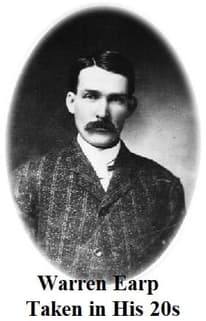
Warren Earp was the youngest brother of the much more famous Wyatt Earp. He missed the Gunfight at the O.K. Corral, but he rode with Wyatt on the vendetta that followed. Afterward, his life slid downhill until he was shot dead in a Willcox saloon in 1900.
Here’s his story, from an Iowa farm to Tombstone, and from Colton, California, to his grave in Willcox, Arizona.
Warren Earp’s Early Life
Warren was born on March 9, 1855, to Nicholas Porter Earp and Virginia Ann Earp (born Cooksey). The family was farming in Pella, Iowa, at the time.
Most references give his full name as Warren Baxter Earp. The Green Valley News reported that the family bible records his first name as Baxter.1 Either way, he went through life as Warren.
Warren had just turned 6 when the Civil War began. His father helped the Union war effort and was often away from home. Warren worked around the farm with his brothers Wyatt and Morgan, while his older brothers Newton, James and Virgil fought with Union troops.
The Wagon Train West
In 1864 Warren’s father moved the family west with a wagon train. Not many details of Warren’s youth are known, but one story may hint at what was to come. Nicholas Earp was chosen to lead the wagon train, probably because of his experience in the Mexican-American War.
Another member of the train, Mrs. J.A. Rousseau, a doctor’s wife, kept a diary. She found Mr. Earp overbearing, grumpy and rigid about his rules. She described one incident involving Warren, who got into a fight with another boy. She didn’t say who started it. She did say Mr. Earp berated all the children, as if to shift the blame away from Warren, and cursed and threatened the parents. According to Mrs. Rousseau, Earp said “if the children’s parents did not whip or correct their children he would whip every last one of them.”5
Growing Up in California
The Earp family reached San Bernardino, California, and settled there in December 1864. The family later moved to nearby Colton. Warren helped in the family businesses, a saloon and a grocery.1 He also learned to drive a stagecoach and did so on occasion to earn money. He owned a racehorse too, all while living with his parents.2
Around 1880 his older brothers headed for Tombstone, Arizona, a booming silver mining town. They planned to take advantage of the money-making opportunities there, and Virgil was a federal lawman. At 25, Warren decided he was old enough to do as his brothers did, and he followed them to Tombstone.
Warren Earp in Tombstone
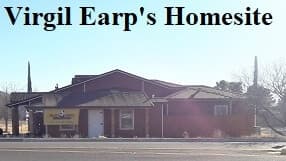
Warren arrived in Tombstone in 1880.3 He moved into Virgil’s house on Fremont Street with Virgil and his wife Allie. When Virgil needed help, he gave Warren part-time law enforcement work.
Did this connection to his brother, and the occasional police work, make him overconfident? Tombstone had an ordinance against carrying firearms in town. Warren broke it and even fired his weapon in town. He was fined $25 for the offense.1
The July 1881 Posse
In July 1881 Warren rode with a posse looking into stolen cattle near the Mexican border, where some of the Cochise County Cowboys were suspected of rustling. Newman “Old Man” Clanton was among the suspected rustlers.6 Some researchers believe the lawmen killed Clanton, though there is no official proof, and the more familiar story has him dying in the Guadalupe Canyon ambush in August 1881.3 Warren was probably wounded in the fight.
His younger sister Adelia later wrote that he came back to Colton and stayed at her house while she nursed him. She said he was “suffering from a wound he received in a fight with rustlers on the Mexican border.”3
So Warren was in Colton when his brothers fought in the O.K. Corral gunfight on October 26, 1881. A revenge shooting followed on December 28: Virgil was ambushed at Fifth and Allen Streets, near the Crystal Palace. He survived, but his left arm was crippled for the rest of his life. When Warren heard the news, he went back to Tombstone to support his brothers.
Warren’s Support After the O.K. Corral Gunfight
Soon after Warren returned, there was another revenge attack on his family. On March 18, 1882, Wyatt and Morgan were in Campbell & Hatch’s Saloon and Billiard Parlor on Allen Street. Shots came through the back door. A bullet hit Morgan in the spine, and he died within the hour. Our Morgan Earp article tells his story.
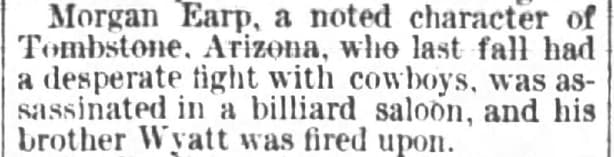
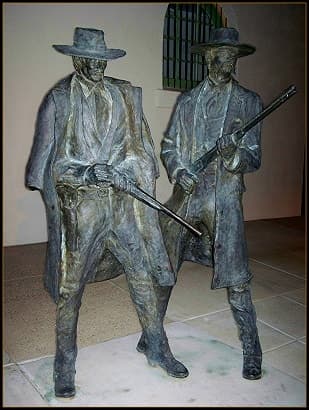
The Earp brothers were consumed with grief and anger. James took Morgan’s body home to their parents in Colton. On March 20, Warren, Wyatt, Doc Holliday and others guarded Virgil and Allie on the train as far as Tucson, on their way to California.3
Other Earp supporters joined them. What followed became known as Wyatt Earp’s Vendetta Ride, as Wyatt’s posse went after the men he held responsible for the attacks on his brothers. Warren was ready to do his part.
The vengeance began at the Tucson station. Frank Stilwell was spotted in the rail yard, and he was shot dead there. Ike Clanton later said Warren was with Wyatt and Doc; historians are less certain about Warren’s role.3
Warren Rides With Wyatt’s Vendetta Posse
The coroner’s jury named Pete Spence, Frank Stilwell, a man called “Fries” and two others as Morgan’s killers. Wyatt planned for his posse to track each of them down. He already felt the courts couldn’t get justice for his family. Stilwell was the first.
Wyatt, Warren, Doc Holliday, Sherman McMasters and “Turkey Creek” Jack Johnson returned to Tombstone, readied their horses, packed supplies and headed out. Ike Clanton said he saw Warren help the others kill Stilwell. Pima County Justice of the Peace Charles Meyer issued arrest warrants for all five.3
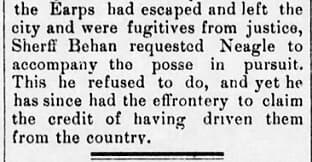
The posse killed Florentino Cruz and Curly Bill Brocius (Curly Bill’s death was never fully confirmed). Wyatt also shot Johnny Barnes, who reportedly died of the wound later. The Earps’ Tombstone nemesis, Sheriff John Behan, formed a posse of his own to arrest Wyatt and the others. In April 1882 Wyatt’s party left Arizona through New Mexico, and Wyatt and Warren went on to Colorado. By 1883 Warren was back in Colton.
Warren’s Downhill Slide
Back in his hometown, without his brothers nearby, Warren’s troubles grew. We can only wonder why:
- Was it the violent death of his brother Morgan?
- Was it that his surviving brothers went their own ways and left him behind?
- Was it his own personality, developing all along?
- Did he tire of being the one who looked different, with dark hair instead of blondish?
- Was it being the youngest boy? Perhaps his parents, particularly his hard taskmaster father, had relaxed the strict upbringing of the older sons by the time Warren came along. Or perhaps his mother spoiled him.
- Was he fighting natural inclinations that he knew weren’t accepted, and acting out because of it?
A psychologist could probably write a book on why he had so many more problems than his brothers.
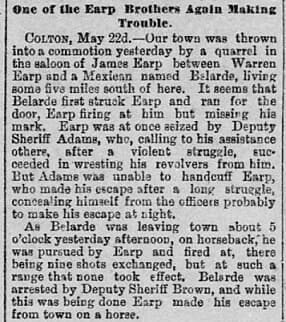
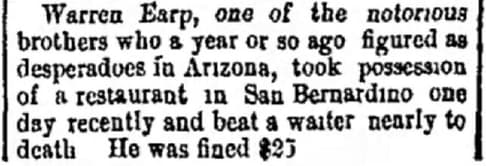
News reports from Colton show a life of drinking and fights, a quick temper and a lot of anger. One reported incident, on May 22, 1883, happened in his father’s saloon. In the spring of 1884, in a San Bernardino restaurant, he took issue with a waiter and beat him badly.
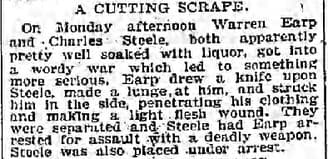
One account places him in Dingle, Idaho, in 1887, married to a Kate Sanford. Little is documented about the marriage, and it doesn’t seem to have lasted. On August 14, 1893, back in San Bernardino, he stabbed a man. He was acquitted.3
Warren finally left his hometown. His father may have pressured him to go; Nicholas was well respected in the area and had served as a justice of the peace.
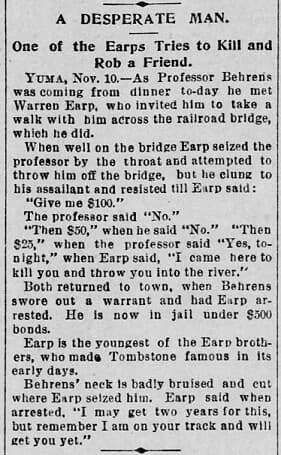
He went to Yuma, Arizona, and was soon in trouble again. On November 9, 1893, he threatened to kill a local professor. The attempted murder charge was dropped, but he was fined and ordered to leave town.3
Warren Earp in Willcox, Arizona
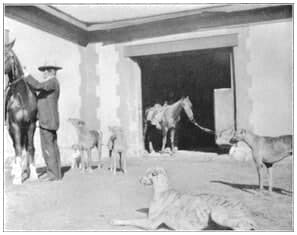
By August 1894 Warren was in Willcox, in southeastern Arizona Territory. He checked into the Willcox House and reconnected with an old Earp family supporter, rancher Henry Hooker of the Sierra Bonita Ranch. Hooker hired him as a range detective.3
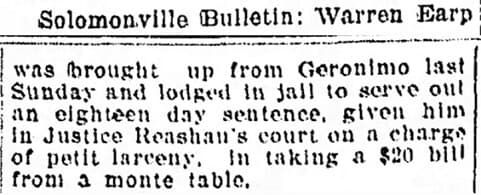
In 1896 he was in trouble with the law again. In the settlement of Geronimo, northwest of Safford, he took $20 from a monte table. He was taken to Solomonville, a little east of Safford, charged with petty larceny, and served 18 days in jail.
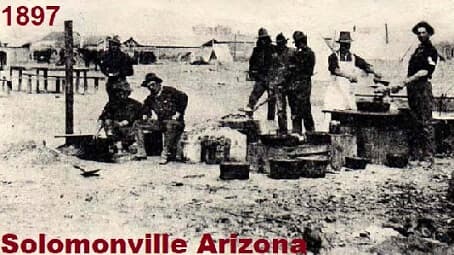
In 1898 Warren registered to vote. Cochise County’s Great Register lists his occupation as “bartender,” a job he had done for his father, so he likely tended bar in local saloons.1
By 1900 he was an experienced freighter and drove the mail stage between Willcox and Fort Grant. Henry Hooker’s ranch was not far from Fort Grant, so he may have kept working for Hooker at the same time.
How Did Warren Earp Die?
Warren was still known around Willcox as an angry, belligerent drunk. For about five years he kept running into a man named Johnny Boyett, in town and probably at work.
Boyett was range foreman for Ed Hooker, Henry Hooker’s son. Ed’s wife, Forrestine Cooper Hooker, described Boyett as “quiet, capable and educated above the average cowpuncher of those days….a fine-looking man, tall, muscular yet slender, with a clean-cut profile….I never heard Boyett use a rough, coarse word, and he did not quarrel with other men.”2 His sister-in-law, though, later wrote that he had fallen in with “bad company.”2
According to reports, Warren bullied Boyett when he was drinking, more and more over time, and Boyett tried to avoid him. In the early summer of 1900, it got worse. Warren found Boyett in a Willcox bar, stuck a gun in his gut, and told him that if they met again in a saloon and argued, there would be a killing.
The Shooting in Brown’s Headquarters Saloon
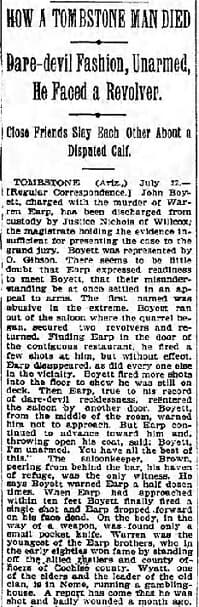
They did meet again in a saloon. At 1 a.m. on Friday, July 6, 1900, both men were in a Willcox restaurant. Warren had been drinking and started abusing Boyett, to the astonishment of the other diners. Then both walked through the door into Brown’s Headquarters Saloon.
According to news reports, customers heard Warren say “Boyett get your gun and we will settle this thing right here. I’ve got my gun, you go and get yours.” Boyett left. When he returned, Warren was gone, but he came back a short time later.
Boyett stood in the middle of the saloon floor as Warren came in through the restaurant door at the rear. Boyett fired some shots his way, and everyone ran out except the owner, Henry Brown, who hid behind the bar. Warren reappeared at the side door.
Boyett yelled at him to stay back. Warren came toward him anyway and said “Boyett, I’m unarmed. You’ve all the best of this!” He opened his coat to show he had no gun. Boyett repeated his warning four or five times, according to Brown.
When Warren was about ten feet away, Boyett fired again and hit him in the chest. Warren fell forward. The bullet had pierced his heart, and he died almost instantly. In his hand was a small, partly open pocketknife. No firearm was found on him.
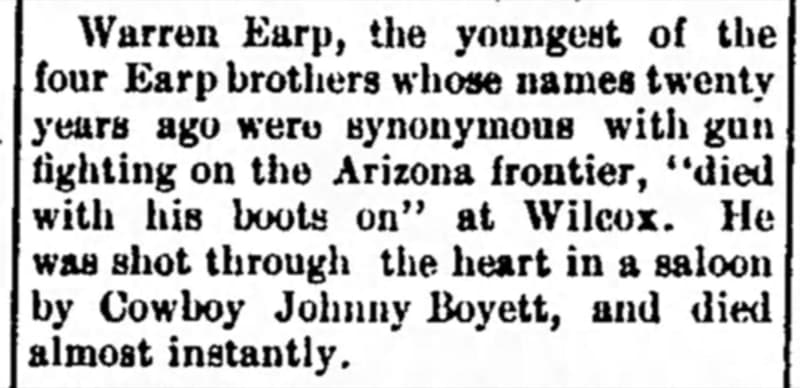
What Happened After Warren Earp Was Killed?
W.F. Nichols, justice of the peace and Cochise County coroner, held an inquest that same day. A bystander, O.W. Hayes, and the saloon owner, Henry Brown, gave the main testimony.
Hayes said the two men walked into the saloon together. After they talked, he heard Warren tell Boyett “You was paid $150 at one time to kill me. Go get your gun. I have got mine.”3
Judge Nichols found the evidence insufficient to indict Boyett, accepted that he had acted in self-defense, and released him.2 Some suspected the pocketknife had been placed in Warren’s hand to support Boyett’s story.2
How Did This Gun Versus Knife Happen?
Some have speculated that the trouble between Warren and Boyett came from the two of them being gay, perhaps fighting an attraction to each other while staying in the closet, as was common in those days. The conjecture rests on a few things:
- Johnny Boyett had no wife or children, as far as the records show. Put that together with Forrestine Hooker’s description of him.
- Warren Earp was single nearly all his life, apart from one short marriage that is barely documented.
- The strongest hint comes from Mary Katherine Harony, better known as Big Nose Kate. When Warren was killed, Kate lived not far from Willcox and worked at the Cochise Hotel in Cochise, west of Willcox. In the 1930s she reportedly told a priest that Warren Earp’s death “was the result of an altercation between two individuals involved in an unnatural male relationship.”4
Visiting Warren Earp’s Willcox
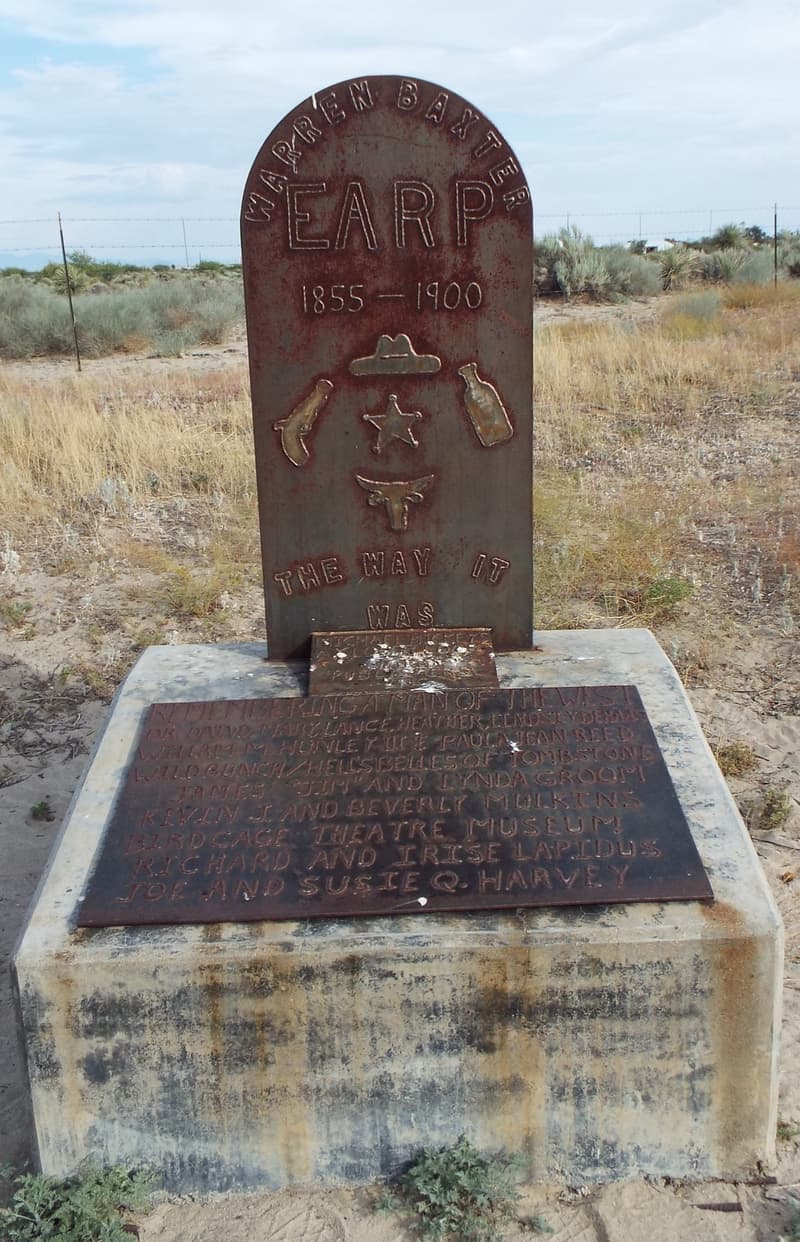
Warren was buried in the Willcox Pioneer Cemetery. According to local sources, his marker stands only near the actual grave, because the grave wasn’t marked right after the burial.
A Warren Earp memorial was dedicated in Willcox on July 8, 2000, a hundred years after his death.3
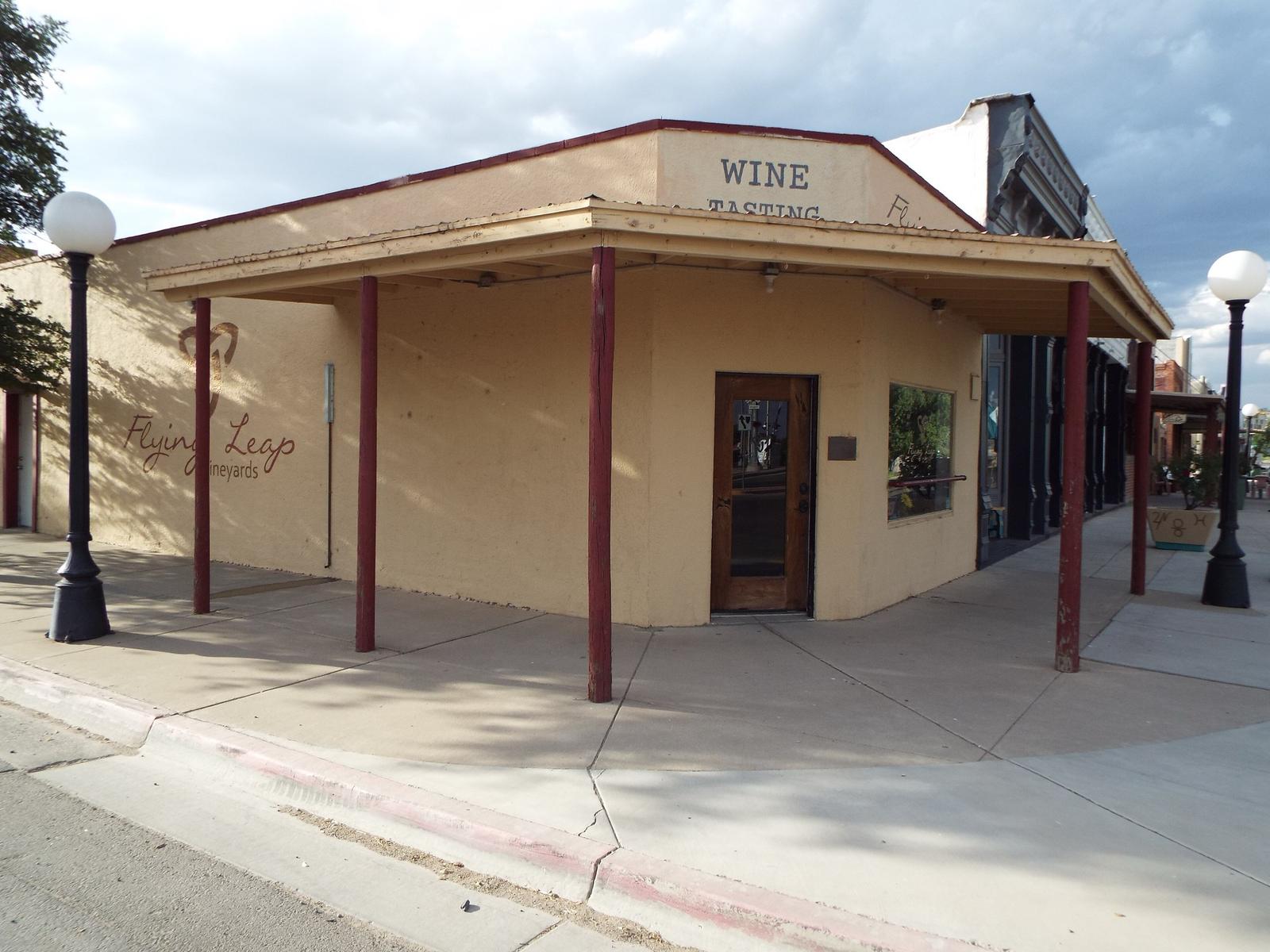
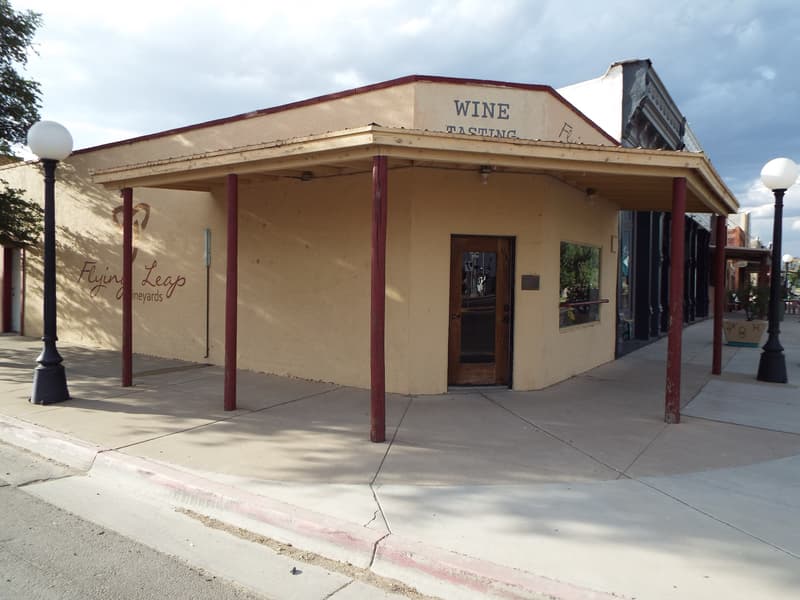
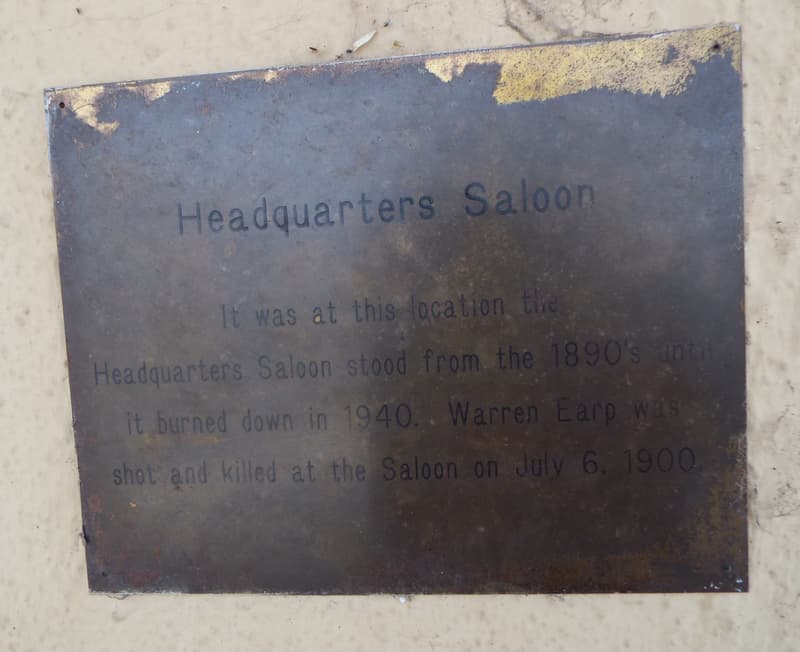
The Headquarters Saloon burned down in 1940. A newer building stands on the northeast corner of Railroad Avenue and Maley Street, across from Railroad Avenue Park, and an Arizona Historical Society marker tells the story. When we visited, the building was a wine-tasting room.
The Cochise Hotel
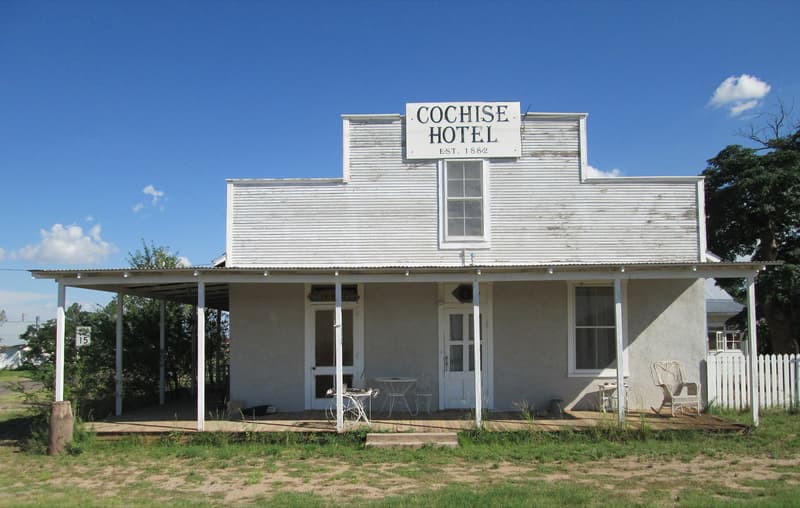
The Cochise Hotel, where Big Nose Kate worked, is a short drive west of Willcox. Today it describes itself as a historical landmark, bed and breakfast, and museum.
References
1 Dyke, S. (April 26, 2017). Meandering the mesquite: in his brothers’ shadows — Warren Earp’s story. Green Valley News. Retrieved January 15, 2018 from http://www.gvnews.com/get_out/meandering-the-mesquite-in-his-brothers-shadows-warren-earp-s/article_8d917d66-2918-11e7-8c3b-33114d52cc7c.html
2 De La Garza, P. (2017). Texan Johnny Boyett was the man who gunned down Warren Earp. Originally published in Wild West February 2014. Retrieved January 13, 2018 from https://www.historynet.com/texan-johnny-boyett-man-gunned-warren-earp/
3 Wild West (June 12, 2006). Warren Earp: The little brother. Retrieved January 15, 2018 from https://www.historynet.com/warren-earp-the-little-brother/
4 Bell, B.B. (October 23, 2015) Warren Earp’s lover?. Retrieved January 15, 2018 from https://truewestmagazine.com/was-warren-earp-gay/
5 Clavin, T. (2017). Dodge City: Wyatt Earp, Bat Masterson, and the wickedest town in the American West. New York: St. Martin’s Press.
6 Traywick, B.T. (1996). The Clantons of Tombstone. Los Angeles: We Print It, Inc.
No comments yet