
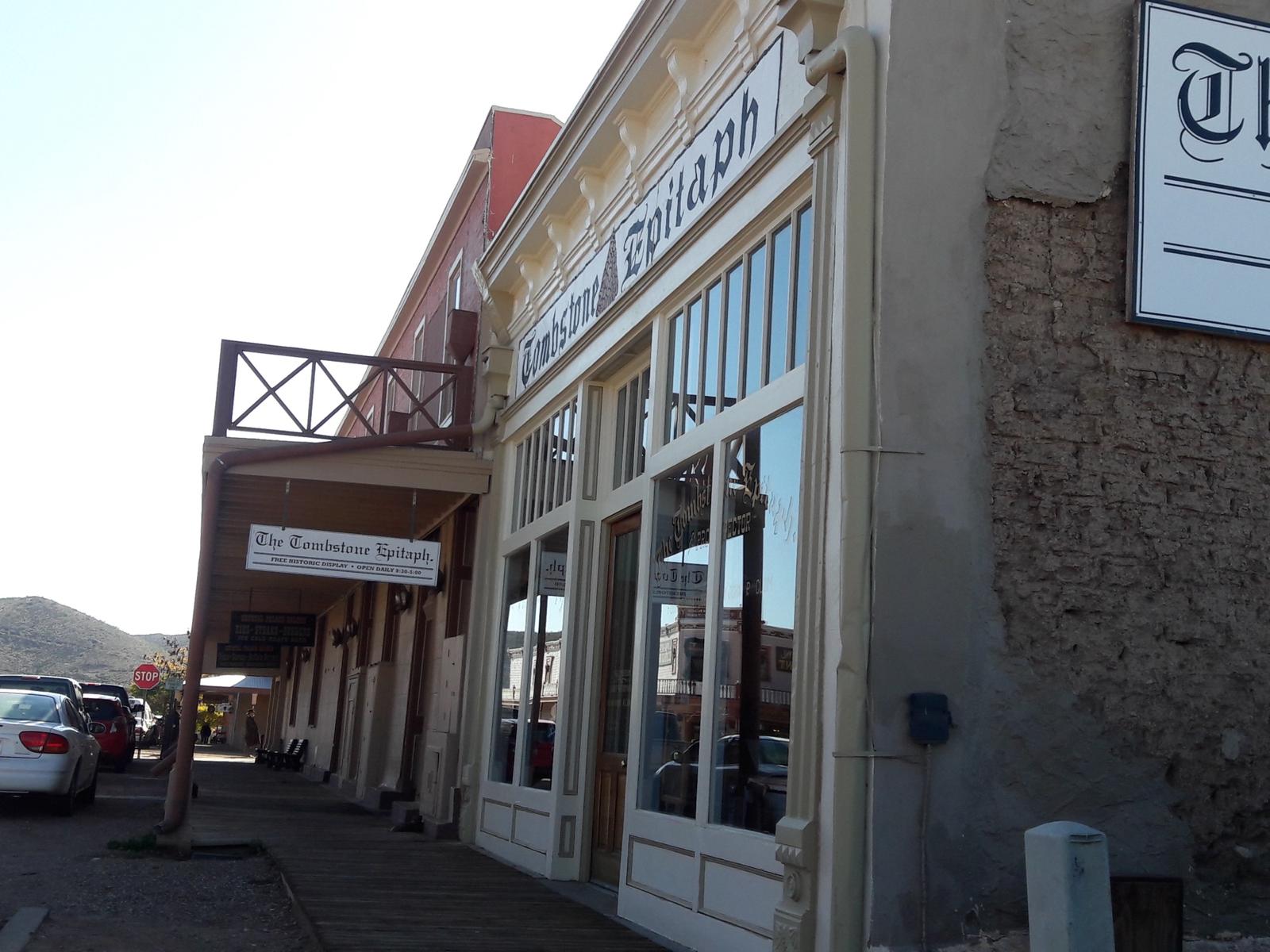
John Philip Clum, born in upstate New York on September 1, 1851, became one of Tombstone’s best-known residents. He was the town’s first elected mayor after it was incorporated, and he founded the Tombstone Epitaph.
Before Tombstone he was an Apache agent, and after it he carried the mail to the Alaska gold fields. Here’s how John P. Clum got to Tombstone, and where he went next.
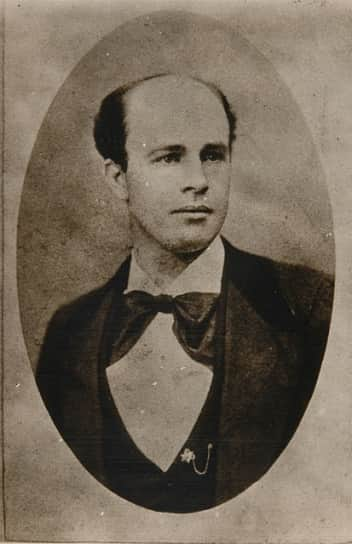
An Educated Upbringing
Clum grew up on a farm near Claverack, New York. He went to a prep school and a military academy there, then on to Rutgers College. Illness cut his studies short before he could graduate.
Once he recovered, he joined the U.S. Army Signal Corps, which was setting up a weather service, and in 1871 he was sent to open a weather observation station in Santa Fe, New Mexico. That was his move west.
Clum kept up his religious interests in Santa Fe. He joined the Presbyterian congregation and became involved enough to serve as a delegate to the church’s General Assembly.
Apache Agent at San Carlos
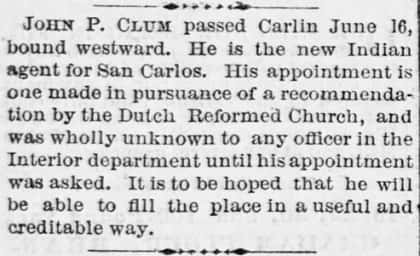
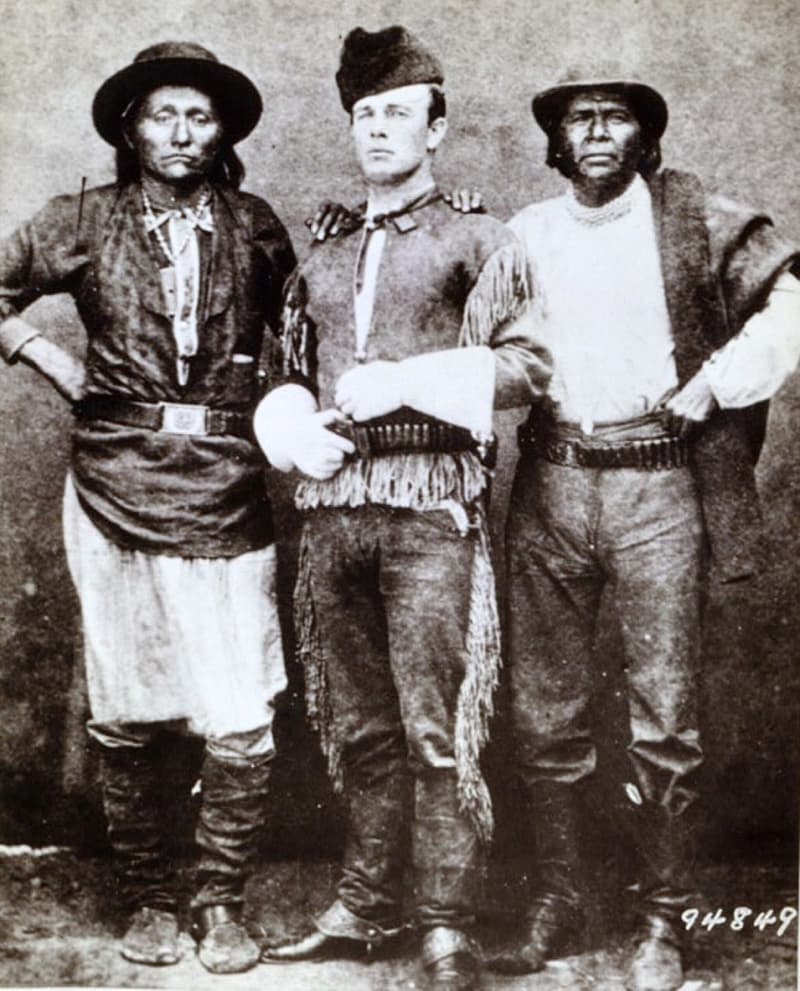
He stayed in New Mexico until he was recommended for appointment as Apache agent in Arizona. He arrived at the San Carlos Reservation on August 8, 1874.
John Clum used methods that weren’t especially popular with the government. He learned about Apache culture and tried to understand the people’s motivations. He organized an Apache police force to keep order on the reservation and brought in a limited form of self-government.
The reservation lies along the Gila River, a reliable source of water in this desert country, and Clum saw farming as a way forward. He taught agriculture, hired Apache workers for building projects and started schools for the children.
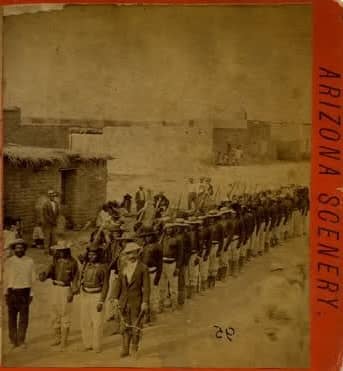
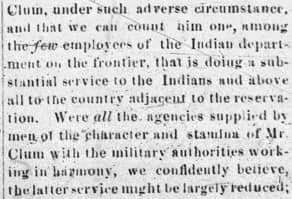
Many praised his work as agent, and most judged he did an excellent job, especially compared with his predecessor. In April 1877 his Apache police captured Geronimo at Ojo Caliente, New Mexico, without a shot fired.
John lived on the reservation but still traveled, and he studied law there. He met Mary Ware, known as Mollie, and married her in Delaware County, Ohio, in November 1876. They lived together at San Carlos.
By the spring of 1877 he was in a bitter dispute with General August Kautz, the Army commander in Arizona, who attacked Clum’s San Carlos policies. Fed up, John resigned that summer, but the argument went on.
Law and Newspapers in Florence and Tucson
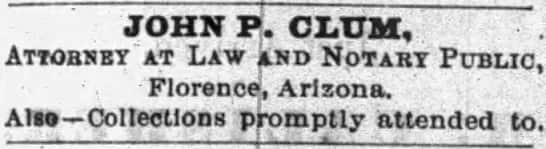
John and Mollie moved to Florence, Arizona, between Tucson and Phoenix. He continued his law studies with Judge H. B. Summers, passed the bar and practiced in the Pinal district court.
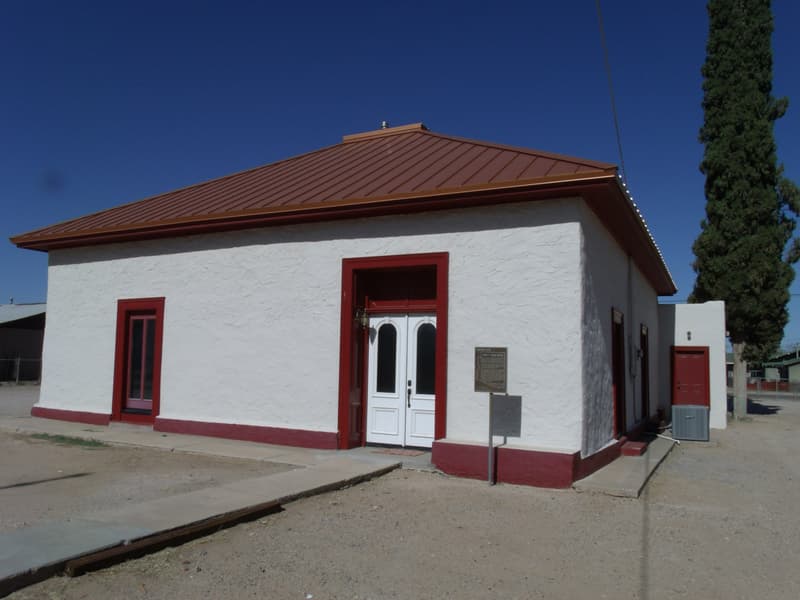
In November 1877 he bought the Arizona Citizen and moved it from Tucson to Florence. By December he had given up law to be a newspaperman full time. In 1878 the Clums built a home at 180 N. Granite Street in Florence, which still stands, and John kept the newspaper’s offices there.
He found it better to return the Citizen to Tucson, and moved there with it in late 1878, turning it into a daily. By early February 1880 he had sold the paper. He stayed involved in politics, helping get Tucson’s Republican Party off the ground and running for office. In April he moved his wife and son Woodworth to Tombstone.
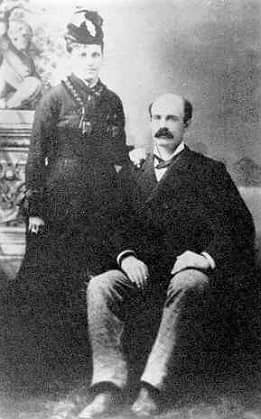
John Clum in Tombstone
Founding the Tombstone Epitaph
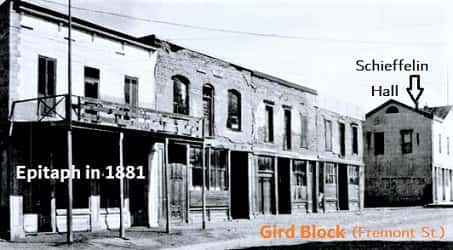
Clum came to bring a newspaper to town. The first weekly Tombstone Epitaph came out on May 1, 1880, from a canvas tent on Fremont Street between 3rd and 4th. By July he had added a daily edition, and he had just been appointed postmaster.
On December 11, 1880, Mollie gave birth to a baby girl, Bessie. She died of fever a week later, on December 18, leaving John a widower. His parents, then living in Washington, D.C., took in the children, leaving John to devote himself to work.

Mayor in the Earp Years
In January 1881 Tombstone’s first election under its new charter made John P. Clum mayor. Soon a solid building, pictured above, replaced the Epitaph‘s canvas office.
Clum stayed involved in the community and wasn’t without controversy, including over the town’s gun ordinance, Ordinance 9. The Epitaph backed the Earps after the gunfight at the O.K. Corral, though the city council suspended Virgil Earp as police chief. Clum and others received threatening letters, and on December 14, 1881, he was on a stagecoach when it was attacked.
Clum went back east to see his children, and his infant daughter died. He lost his post office position in June 1882 and remarried in Washington, D.C., in February 1883. He was postmaster again in February 1885 but resigned that autumn. In February 1886 Tombstone’s Anti-Chinese League targeted him for a boycott (see immigration in the 1800s), and by March he was city recorder.
Later that year he moved to San Bernardino, California, done with Tombstone life.
Moving On: Alaska and Beyond
Clum stayed in San Bernardino for a while, working in real estate and at a newspaper. Around 1890 he went east for a federal job with the Postal Service. In early 1893 he also began lecture tours, illustrated with stereopticon slides, and in November 1897 he was appointed chief clerk of a division under the chief postal inspector.
In April 1898 he was sent to Skagway, Alaska, to set up postal service, and he traveled throughout the gold-rush towns.
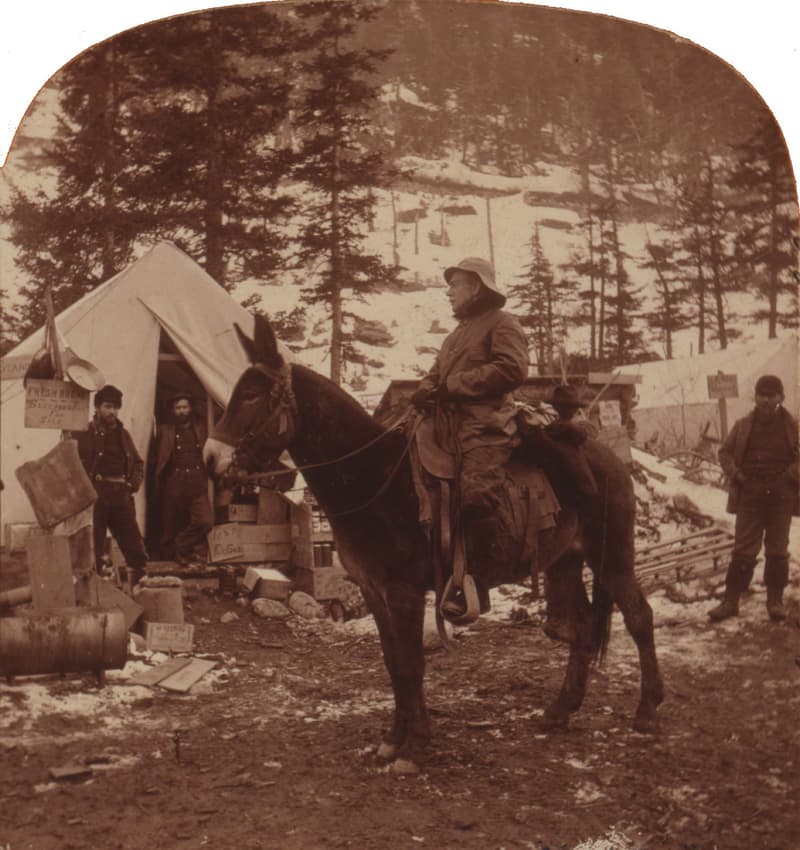
In 1900 he was in Nome, where he met up with his friend Wyatt Earp. Controversy found him again in June 1903, when his gold mining interests raised conflicts with his position.
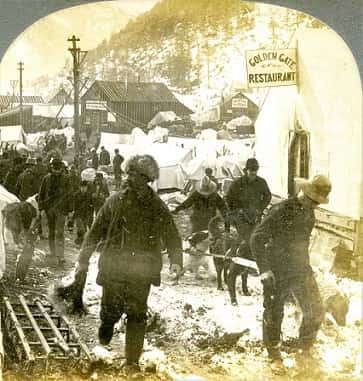
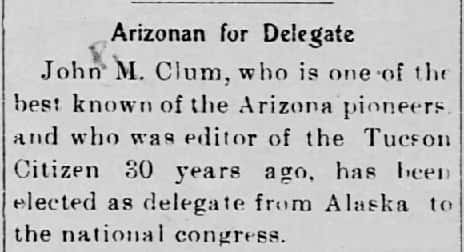
Even so, by early 1906 he was postmaster in Fairbanks. He was mentioned as a candidate for governor of the Alaska district, which didn’t happen, and his friends put him forward as a nominee for territorial delegate to Congress.
Later Years and Return Visits to Tombstone
John left Alaska in 1909 and became a postal inspector in Denver. He retired from federal service in April 1911 and went back to lecture touring from a home base in California. Bisbee and Tombstone were stops in May 1912. That autumn his wife died. He kept writing for newspapers and journals as he toured.
Sentimental about Tombstone, Clum was the first to donate to the restoration of Boothill, where Mollie is buried. In the summer of 1929 he served on the advisory committee for the first Helldorado celebration and came back to Tombstone for it. In 1930 he joined the Arizona Pioneers’ Historical Society.
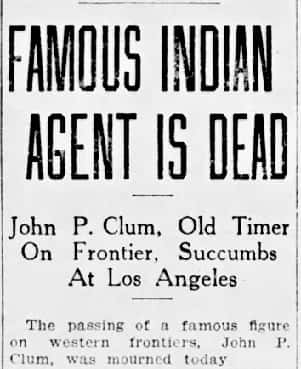
He died on May 2, 1932, at the age of 80. We haven’t even covered all his roles here. He certainly led quite a life.
No comments yet