It wasn’t easy for women to make their way in the Old West, and it isn’t always easy to find them in the records either. In newspapers of the time, even women of note often go without a first name. Married women were usually described by their husband’s name, so Allie Earp appears as “Mrs. Virgil Earp,” and sometimes women are mentioned without being named at all.
That’s what we run into when we do our research. Here are some of the historic women of the Tombstone area, grouped loosely; several of them fit more than one group.
Well-Known Women of Tombstone
Tombstone fans already know the Earp women. They got together to help by sewing canvas tents for miners. We’ve written about Wyatt’s Tombstone “wife,” Mattie Blaylock, and our pages on Virgil and Morgan tell the stories of their wives, Allie and Louisa.
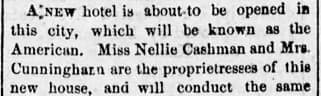
Another popular name is Nellie Cashman, a strong presence not only in Tombstone but throughout the Wild West. She was well known in the mining camps of the time for running restaurants, boarding houses and other businesses, and for her charitable work.
Women Who Made History
Clara Spalding Brown
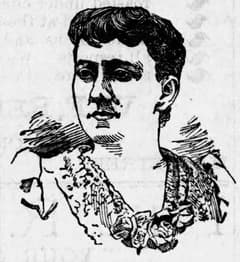
Clara Spalding Brown lived in Tombstone for just over two years. She wrote letters to the San Diego Union describing life in town. Her accounts of everyday life there are extremely valuable. They turned out to be a fabulous historical record, even if she never intended that, and she did go on to earn her living in journalism.
Edith Cole
Edith Cole and her husband Walter took over the Tombstone Epitaph in 1930, when the town was suffering in many ways. The county seat was moving to Bisbee and the silver mines were fading. Tourism was being promoted, and the Coles wanted the Epitaph to help. Walter is often credited with the idea behind the slogan “The Town Too Tough to Die,” though the familiar wording seems to have come later. Edith was involved in many town projects and was well known during their eight years there.
Lozen
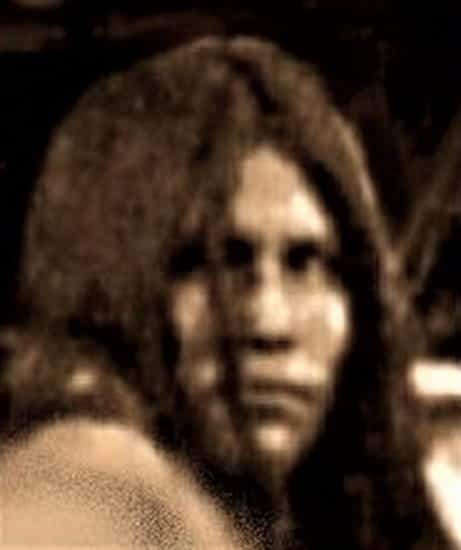
Lozen, a Chiricahua Apache woman, was the sister of Victorio, who spoke highly of her. She was very strong and an excellent strategist, and she was known for helping women and children escape from battles. After Geronimo’s final surrender in 1886 she was sent east as a prisoner of war, and she died in captivity at Mount Vernon Barracks, Alabama, in 1889. For more Apache history near Tombstone, see our article on Apache Pass.
Known Because of a Husband
Lottie Hutchinson
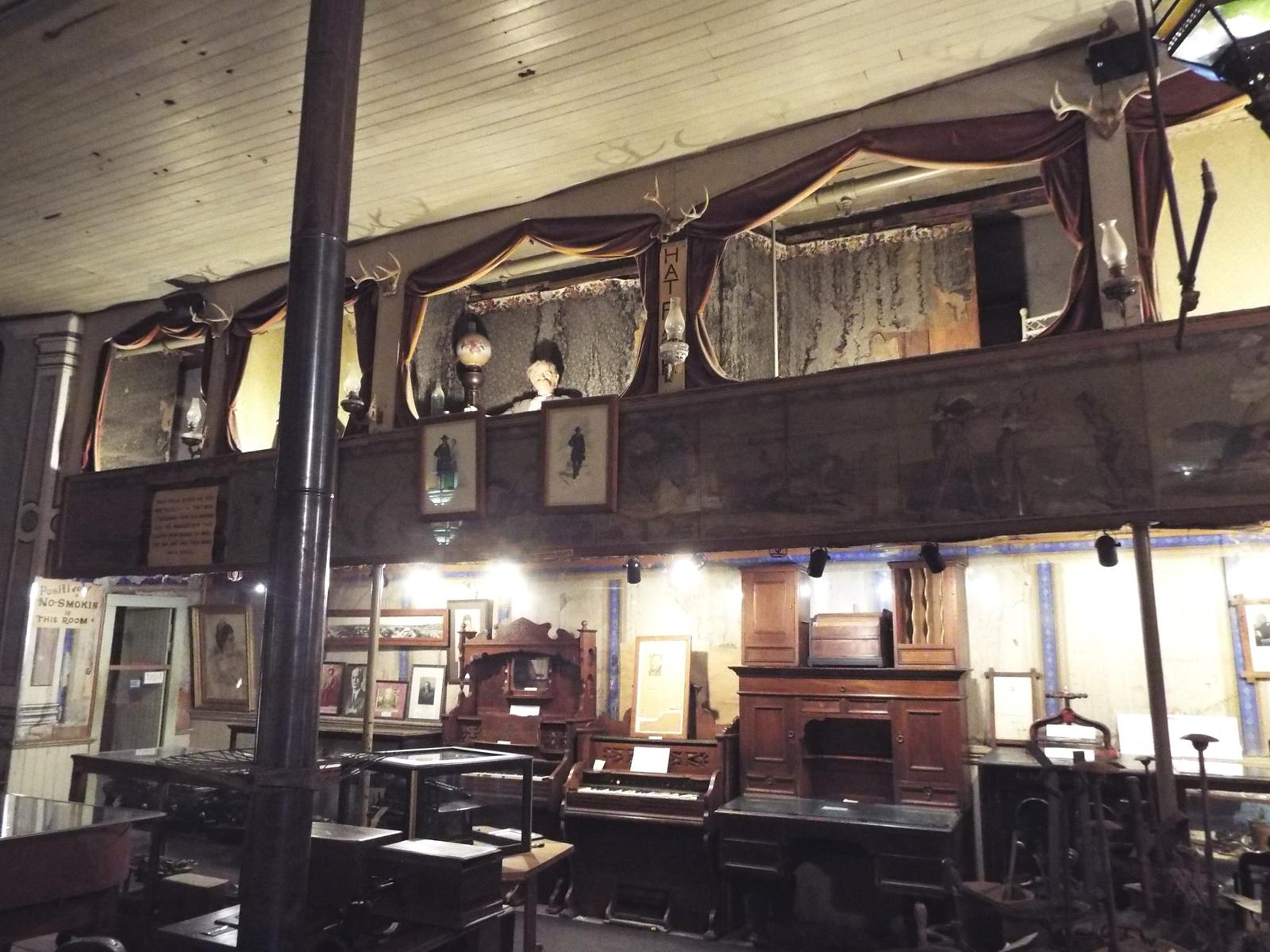
Lottie Hutchinson and her husband William built the Bird Cage Theatre. It was an immediate success. William led the organization, but Lottie was involved in many parts of the productions. She made sure the performers didn’t go too far over the line of “respectability,” and she even performed herself, billed as a “Serio-Comic Queen” and described in one review as “charming as ever.”
Mollie Fly
Mollie Fly was the wife of C.S. Fly. Like him, she was a photographer, but she took a back seat, supporting his work and running their studio. When fire destroyed the gallery in 1912, she saved many of his historic photographs.
Mrs. Pridham
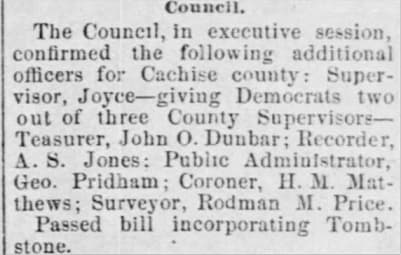
George Pridham arrived in Tombstone around the spring of 1880. We know his wife only as Mrs. Pridham. She supported him while he was a partner in the grocery and produce shop at Allen and Fifth, and while he was treasurer of the Rescue Hook & Ladder company, formed after the June 1881 fire. How do we know? We’re inferring it from diarist George Parsons’s many mentions of Mrs. Pridham and his visits to their home. But we never learn her first name.
Businesswomen in Their Own Right
Addie Borland
Addie Borland lived across Fremont Street from Fly’s studio and the rear entrance of the O.K. Corral. She is remembered for her testimony as a witness to the gunfight in the vacant lot. She ran a dressmaking business from her home. That house is said to have been moved and is now the Four Deuces Saloon.
Samantha Fallon
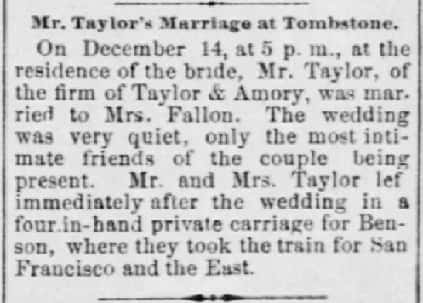
Samantha Fallon arrived in town in 1879, probably already divorced. She built the San Jose House, which then had 20 rooms and still stands at Fremont and Fifth (see our history of Tombstone hotels). It’s said she and Ed Schieffelin were very close friends, and some say he was the love of her life. But she married someone else.
Ethel Macia
Ethel Macia had a great influence on Tombstone. A Tombstone native, she married an up-and-coming mining man in 1904. She was especially active in promoting and preserving the town’s historic buildings, and her family is well known for the famous Rose Tree Inn.
Leonie C. Holly
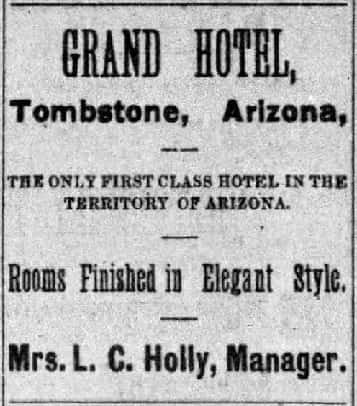
Leonie C. Holly started out in partnership with her husband John. They specialized in hotel management and were hired to run Brown’s Hotel. John died of a laudanum overdose, and in January 1880 Leonie took over herself. She also managed the Rural House for H.G. Howe. When the Grand Hotel opened that September, Leonie managed it too, until the owners, Brown and Comstock, found a replacement.
George Parsons’s Friends
George Parsons kept the diary that gives us much of our view of early Tombstone. Reading it, you can see he moved among the town’s upwardly mobile. He regularly escorted and visited many women in town, yet he also wrote this less than flattering line: “One by one they come and I hope the good, fair and virtuous will soon displace or at least make less prominent, those of a coarse depraved nature who have been so long disporting themselves before the community.” We wonder whether they would have said the same of him.
Miss Bilicke
Miss Bilicke was the daughter of Carl G. Bilicke, owner of the Cosmopolitan Hotel. When Parsons first met her, he noted that he had glimpsed her many times before, and he clearly knew the family. After the devastating fire of May 1882, the Bilickes moved to California and ran hotels there.


Sue Santee
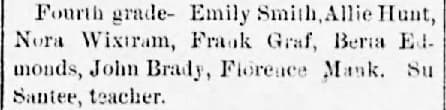
Sue Santee taught in Tombstone’s first school. Parsons first mentions her on February 27, 1882, worried that a sudden illness might end her life. But all seems well by April, when he notes seeing her a few times, once even on a date of sorts.
Kate Goodfellow
Mrs. Kate Goodfellow was the wife of Dr. George Goodfellow. Parsons had met the couple in San Francisco before Tombstone. He spent a lot of time with the doctor, but he also visited Mrs. Goodfellow on his own, regularly. Her health wasn’t sturdy enough for frontier life.
Notorious Women
Were they bad women? Outlaws? Victims of their circumstances? Probably all of the above. Here are some who came through town.
Mollie Williams Bradshaw
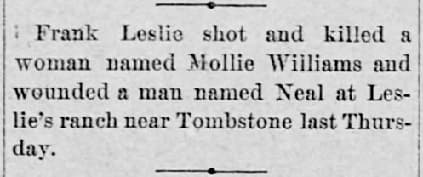
Mollie Williams Bradshaw made a name for herself through her association with Buckskin Frank Leslie. When she first came to Tombstone she performed at the Bird Cage Theatre, and she also worked as a prostitute under the name Blonde Mollie. Taking up with Frank was her undoing.
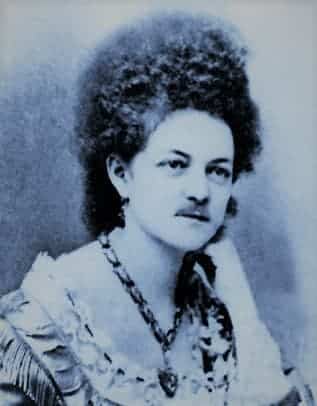
Madame Moustache
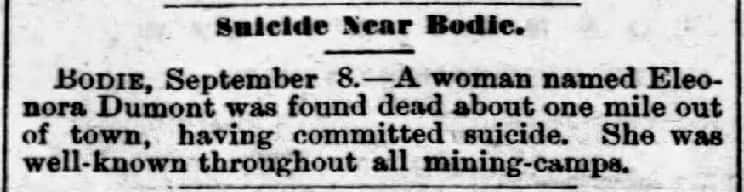
For most of her life Madame Moustache went by Eleanor Dumont. She was first noticed in Nevada City, California, as a woman card dealer, a rarity that drew attention. She moved around the West dealing cards and was reported in places like Pioche, Nevada; Deadwood; Bannack, Montana; San Francisco; and Tombstone. Her nickname came from the growth on her upper lip. She ended up in Bodie, California, on a losing streak, and died there in 1879.
Big Nose Kate
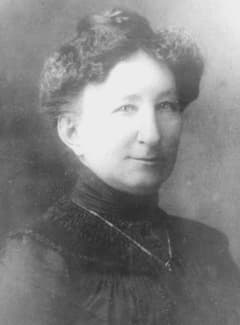
Finally, maybe the most notorious of all: Big Nose Kate. She was born in Hungary as Mária Izabella Magdolna Horony and came to the U.S. as a child. She met Doc Holliday in Fort Griffin, Texas, in 1877. They had a tumultuous relationship, and she was with him in Tombstone. Once she came to Arizona, that’s mostly where she stayed, and she is buried in Prescott.
Finding the Real Women of Tombstone
Historic places and events make us curious about the people who roamed Tombstone and the Old West. What’s the true story? Can we find the authentic history? We enjoy sharing what we find, and we hope that when you visit, you’ll think of these women as you walk the streets where they spent their days in the 1800s.
No comments yet