People love trivia, and when it comes to Tombstone, Arizona, you can amaze your friends and relatives with what you discover. Here are some lesser-known Tombstone details we’ve dug up, many of them from the town’s old newspapers.
Hauntings to Discover
With its wild history, Tombstone is known for quite a few haunted spots. Even walking the streets on a quiet night, you may get a chill.
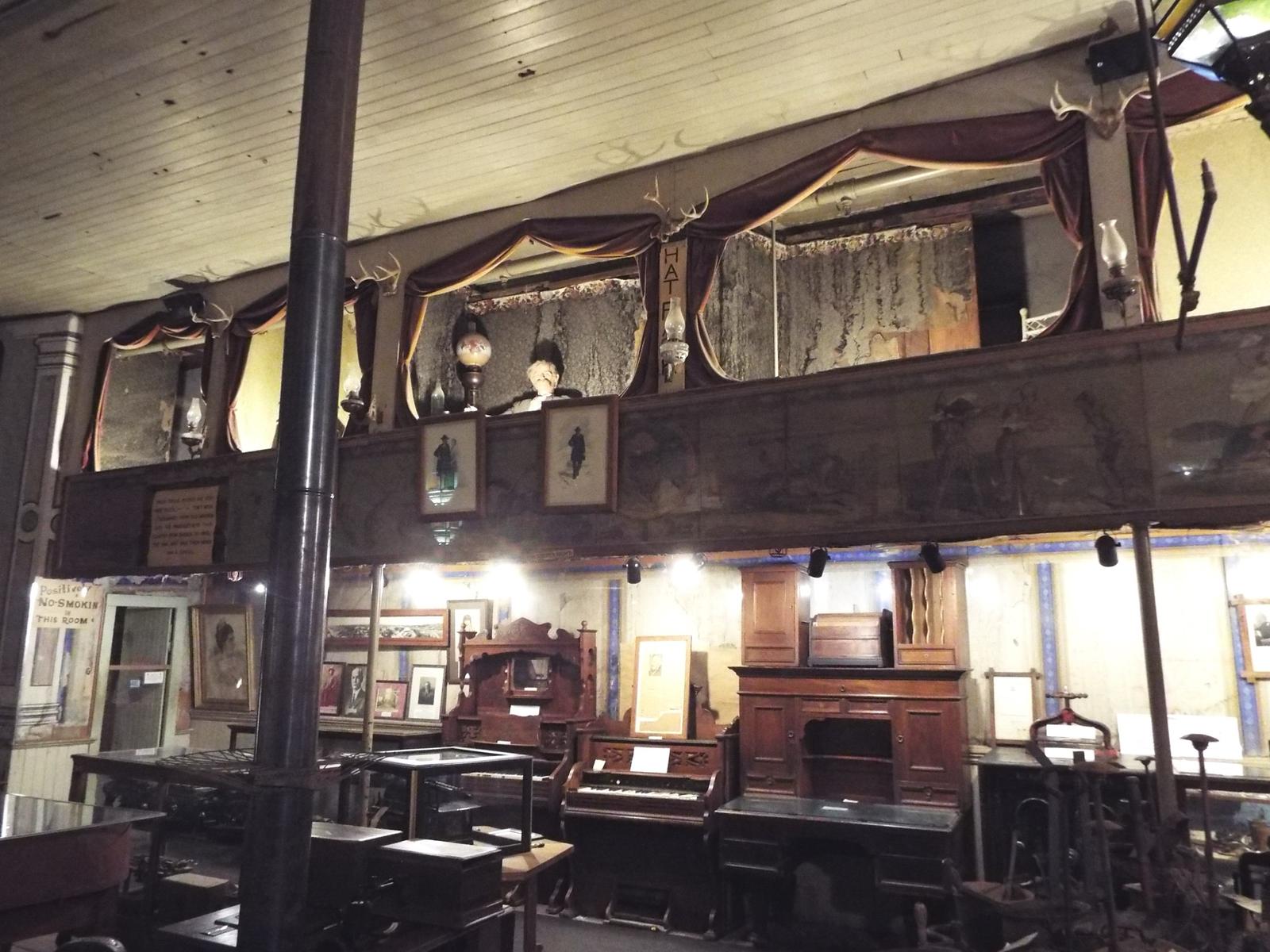
You may have heard some of the better-known haunted Tombstone stories, such as those about the Bird Cage Theatre. Big Nose Kate’s Saloon has its own legend, The Swamper. That’s a bit of Tombstone trivia few people know until they go into Big Nose Kate’s and read about it. Our Haunted Tombstone page covers the ghost tours you can try.
One lesser-known spot is the Brunckow Cabin, about seven miles southwest of town and a short walk from Charleston Road. It’s unique because it was built by the true first mining settler of the Tombstone area. Most people think of Ed Schieffelin as the original miner here, but Frederick Brunckow formed a mining community in 1859, about 18 years before Schieffelin scouted the Tombstone hills.
Tombstone Trivia
Who Is Buried in Tombstone Cemetery
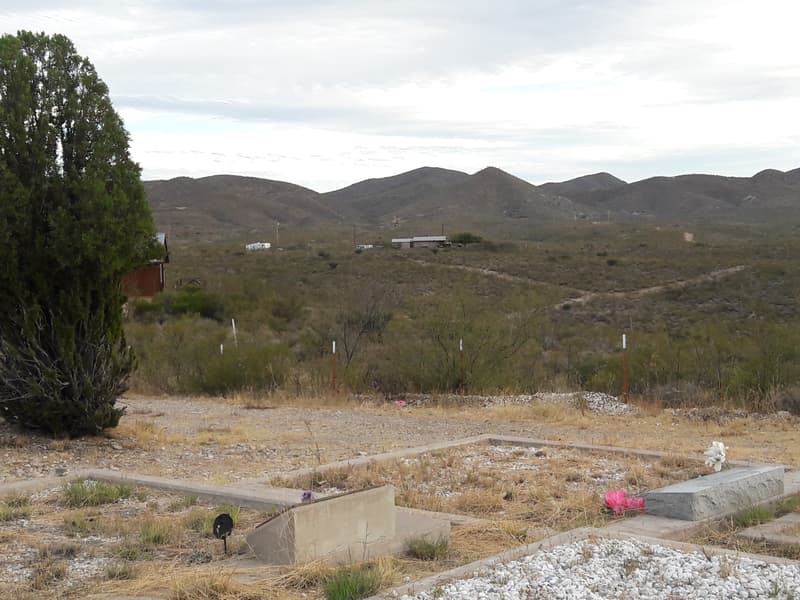
The local Tombstone Cemetery is the newer graveyard, off the western end of Allen Street outside the business district. It became the townspeople’s cemetery after Boothill was neglected and hemmed in by housing.
Some of the people buried here:
- James Lamb, the first burial here, on June 30, 1884.
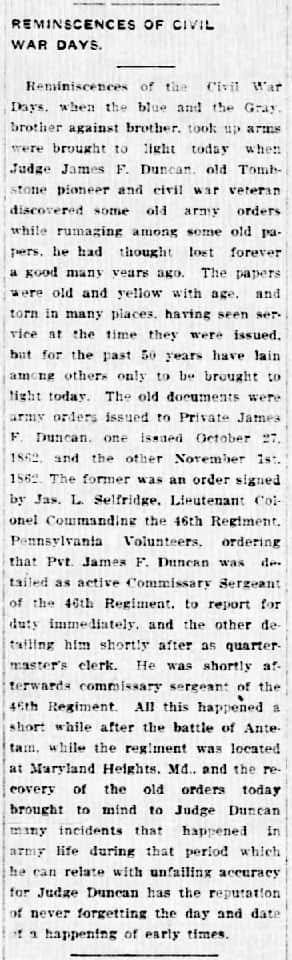
- James F. Duncan, a judge and Civil War veteran. The Epitaph published some of his Civil War reminiscences; the clipping is below. You can also see his gravestone.
- Chief Nino Cochise, said to be the son of Taza and grandson of the great Apache leader Cochise. That’s controversial: the man buried here claimed to be Cochise’s grandson, but if you follow the evidence, or the lack of it, the claim looks quite suspicious.
- Ethel and James “Bert” Macia, a pioneering Tombstone family and historic owners of the Rose Tree Inn, now the Rose Tree Museum.
- John Escapule, a French Basque immigrant and patriarch of a Tombstone pioneer family whose descendants still live in the area. He was a miner (Escapule Mining Association) and a rancher (Lucky Hills Ranch). His descendant Dustin “Dusty” Escapule has served several terms as Tombstone’s mayor.
- William Arthur Harwood, Tombstone’s very first mayor, who served as interim mayor when the townsite was made official until municipal elections were held. He was the town’s lumber dealer and became an owner of Schieffelin Hall.
- Walter J. Meyer, the Boy Scout leader whose troop cleaned up Boothill in 1926 and 1927 so it could be visited.
- Camillus S. Fly, the famous Old West photographer, whose gallery on Fremont Street was also a boarding house where Doc Holliday roomed for a while. Read the C.S. Fly story.
Early Religion in Tombstone
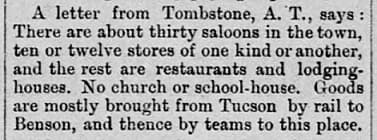
Methodist Reverend George H. Adams organized the first public church service in town. No church had been built yet, so on October 8, 1879, he gathered people in Wise’s Store in the Brown Building for a sermon. Afterward he baptized the first baby born in the mining camp, a girl born to Mrs. Fuller and named Inez. The whole town celebrated.2
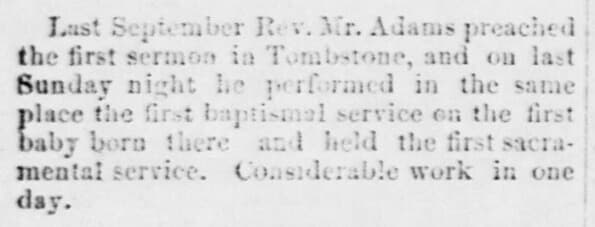
The Methodist Episcopal Board then decided to start a formal local church. Methodist minister Joseph P. McIntyre came to town in February 1880, and by October an adobe chapel had been built, where McIntyre stayed to minister.
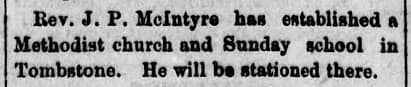
Reverend James Woods was sent to start a Presbyterian congregation. He held its first service in Ritchie’s Hall on August 15, 1880, and stayed until the wood-frame church on Fourth Street was finished at the end of October.
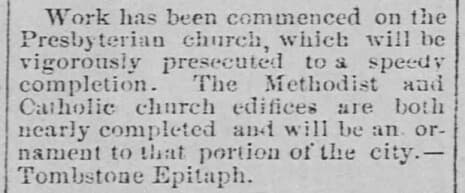
The Baptists organized a church in town on April 26, 1881, with Reverend U. Gregory sent from Tucson to set up the congregation.
With the local Hispanic population and a growing Irish immigrant community, there were many Catholics in town. From 1879, Father Antonio Jouvenceau, sent by the bishop in Tucson, visited a few times and said Mass in parishioners’ homes or in meeting rooms at stores and bars.
Two lots were donated for a church, and on January 1, 1881, an adobe building was completed as the Sacred Heart of Jesus Catholic Church. Mass was held on the first floor, and a half-size second floor served as the rectory. In 1882 a wood-frame church was built next door so the adobe could become the rectory. Both buildings have been restored and still stand at the corner of Sixth and Safford Streets.
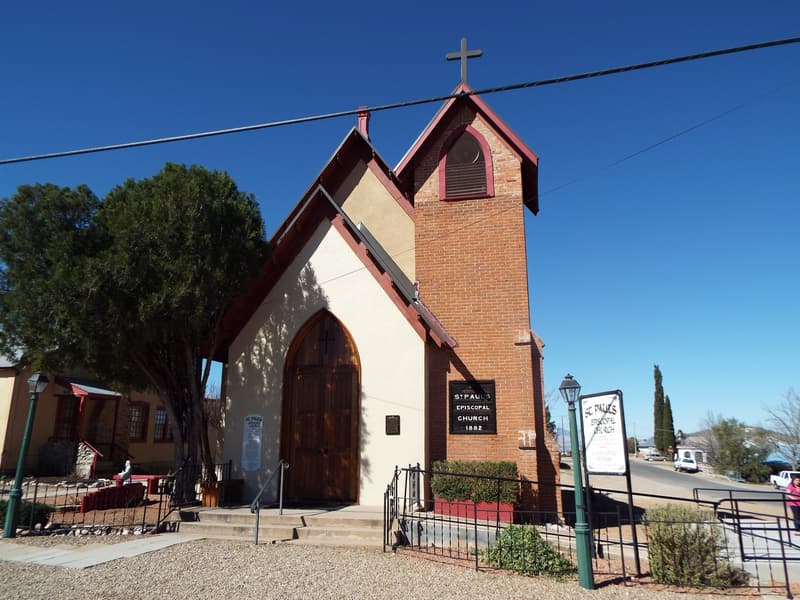
Tombstone’s best-known historic church came a little later. St. Paul’s Episcopal Church at Safford and 3rd Streets opened in June 1882, built under Endicott Peabody, a young Episcopal seminarian.
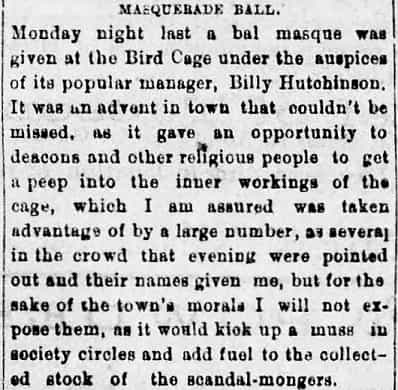
Not every churchgoer stayed away from the Bird Cage, though, as this 1882 item reports.
Cow-boys in the News
Cow-boys were a regular newspaper subject as the West expanded in the 1800s, and the Wild West made for plenty of lurid stories.
Cow-boy news traveled from one end of the country to the other. Under the heading “Border Life,” the Philadelphia Inquirer of Saturday, January 7, 1882, ran a short item filed from San Francisco the day before. It begins, “A despatch [sic] from Tombstone, Arizona…” and tells of raids by renegade Apaches, then adds that “Cow:boys are raiding the cattle ranches in the vicinity of Tombstone.”
More trivia about the Cochise County Cow-boys:
- The Arizona Daily Star reported that Roger King (an alias), a member of the Kearney Sand Lot gang, shot and killed a Mr. Wilson in a saloon on Allen Street on the morning of Sunday, August 1, 1880.
- The Arizona Daily Star reported that at about 6 p.m. on Tuesday, December 21, 1880, “Red Mike” was shot through the arm at the Alhambra Saloon. The shooter, who fired several times, was not identified.
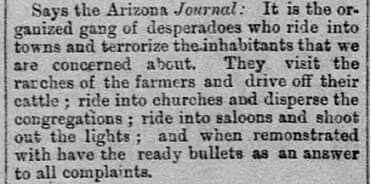
- A report from the Arizona Journal, quoted by the Sacramento Record-Union on Monday, March 28, 1881, was scathing about the Cow-boys.
- On Saturday, October 29, 1881, Sacramento’s Record-Union reported that Major Downing had suspended the lumber trade out of Fort Bowie, which supplied Tombstone, because of a “raid by cowboys,” adding that “authorities seem powerless to cope with this gang…”
- A Tombstone-Bisbee stage was robbed of a strongbox holding $6,500. The express messenger grabbed his Winchester and fought the five robbers, and nobody was hurt. The Green Bay Weekly Gazette reported this cow-boy holdup of Friday afternoon, January 13, 1882.
- According to The Buffalo Commercial (New York), a sheriff’s posse tracked down a group of cow-boys on Wednesday morning, March 29, 1882. In the shoot-out, Deputy Gillespie was killed and Deputies Allen and Young were wounded. Billy Grounds was killed and Zwing Hunt badly wounded.
- On Friday, August 11, 1882, the Weekly Republican quoted a somewhat sarcastic note from the Tombstone Independent about Phoenix coverage of Tombstone: “The Phoenix papers are fairly lurid with the account of the cowboy’s recent attempt to take the town.”
- On Saturday, June 30, 1883, the Arizona Weekly Citizen passed on a warning from the Tombstone papers that “rustlers are again abroad,” advising that “Cachise [sic] county should remember the disgrace that was brought on her two years ago by rustlers.”
Notable Characters
- Doc Holliday‘s uncle, Dr. John Stiles Holliday, diagnosed the infant John Henry’s cleft palate and referred his parents to Dr. Long, who corrected it with surgery. A young woman of mixed race who worked in the uncle’s household helped entertain Doc and his cousins. She taught them card games, including one called Skinning, which was similar to faro, the game Doc would later deal professionally.
- Wyatt Earp had an older half-brother, Newton, the oldest son of Nicholas Earp and his first wife. Not much is written about him. He was closest in age to James and Virgil. He ran against Wyatt for constable and lost by 29 votes. He had five children, lived to be 91 and never lived in Tombstone.
- Dr. George Goodfellow was a well-known Tombstone physician in the early 1880s. When he left the Army and moved to Tombstone, he asked for his medical bag and surgical equipment to be sent after him. Major Hutchings sent them on a government coach driven by Frank Sullivan. The package arrived with items missing. Sullivan had stolen them, meaning to sell them to a Dr. Watson, who grew suspicious, and Sullivan was arrested.1
Miscellaneous Tombstone Trivia
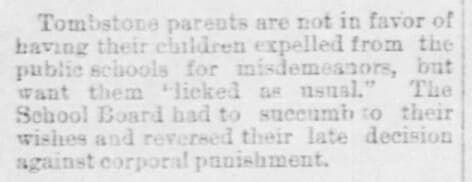
- As the item above shows, Tombstone parents in 1883 wanted misbehaving children given corporal punishment at school rather than expelled.
- In 1902 a marriage license for Tombstone residents cost $2.50 from Cochise County.
- The Crystal Palace donated $25 to help San Francisco after the earthquake of April 18, 1906.
- In 1881 a male teacher in Arizona earned $86 a month and a female teacher $73.
- In Tombstone’s first official mayoral election, 697 votes were cast.
- In mid-1884, $1 bought eight drinks in a Tombstone saloon.
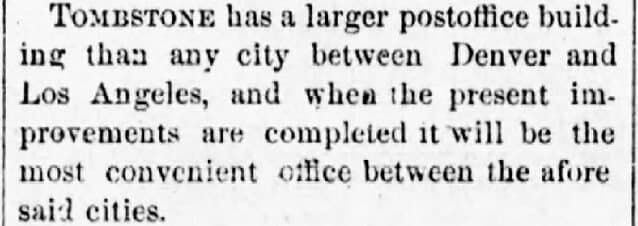
- Before the devastating fire of May 1882, the post office stood at the southeast corner of 4th and Fremont Streets. It was an impressive building, and the town was still improving it that March, but the fire took it down. Read more in our Tombstone history.
References
1 Arizona Daily Star (1880, Nov. 19). Nipped in the bud. Page 3. Retrieved from Newspapers.com.
2 Bailey, L.R. (2004). Too tough to die: The rise, fall and resurrection of a silver camp; 1878 to 1990. Tucson AZ: Westernlore Press.
No comments yet