Vogan’s Saloon was a Tombstone establishment of the 1880s: a liquor sample room that for a time had its own bowling alley, and a place where Old West history happened.
In much later years the building reopened as a “greasy spoon” restaurant and bar, then closed again and sat for sale for a long time while deals came and went. Here is its early history, the stories that took place inside, and our own chance meeting with its longtime owner.
Early history of Vogan’s Saloon
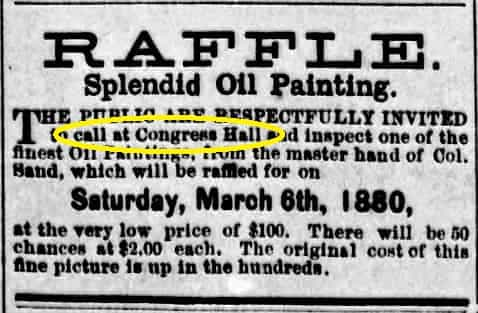
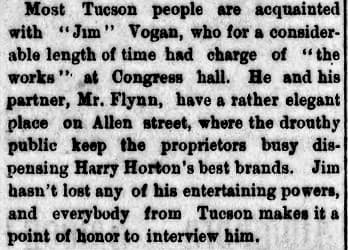
James Vogan came to Tombstone from Tucson, where he had managed a saloon called Congress Hall in what is now the center of town. Doc Holliday gambled there on occasion when he was in the area.
Congress Hall was a deluxe place, often called a resort. It offered plenty of entertainment, along with rooms and halls for public events.
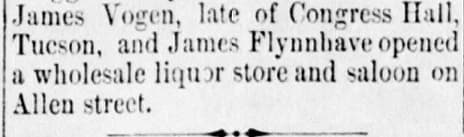
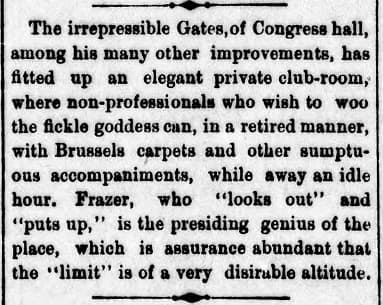
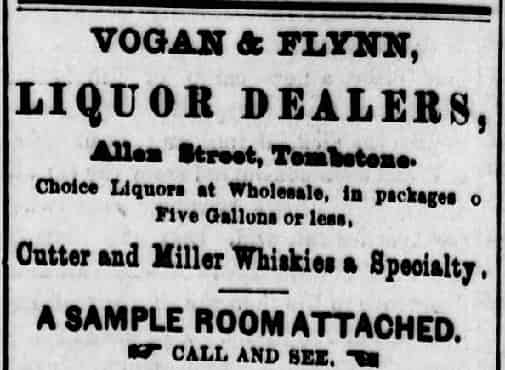
Jim Vogan left Congress Hall to go into business with James Flynn. Both came to Tombstone in 1879, and at the beginning of 1880 they opened a saloon on Allen Street called Vogan & Flynn’s.4 It stood near the southeast corner of Allen and 5th Streets.
Running Vogan’s Saloon
The two Jameses needed help, and they hired a third James: James Earp, older brother of Virgil and Wyatt, who tended bar and dealt faro there. Allie Earp is said to have described James as “always liked as a square gambler that never got into fusses like Wyatt…”8
The saloon had a bowling alley inside, and Tombstone’s licensing laws charged a tax of $4 a month for a ten-pin alley. The saloon also paid a liquor license of $3 to $7 a month on a sliding scale by sales, $10 a month for its gambling, and an extra $7 because it sold hard liquor alongside the gambling.7
In November 1880 Jim Vogan began renting part of his building for shooting events and promptly paid the $3 license tax.7
As soon as the shooting gallery license came through, J. G. Stocks set up “Stocks Shooting Gallery” in the saloon. The newspaper reported that the first contest drew ten entries, and five tied and split the $50 prize. It was so popular that the prize was raised to $70 and more matches were scheduled.7
These license fees paid the city marshal’s salary and other city services, and gave some support to local people in need.7
What Vogan’s was like
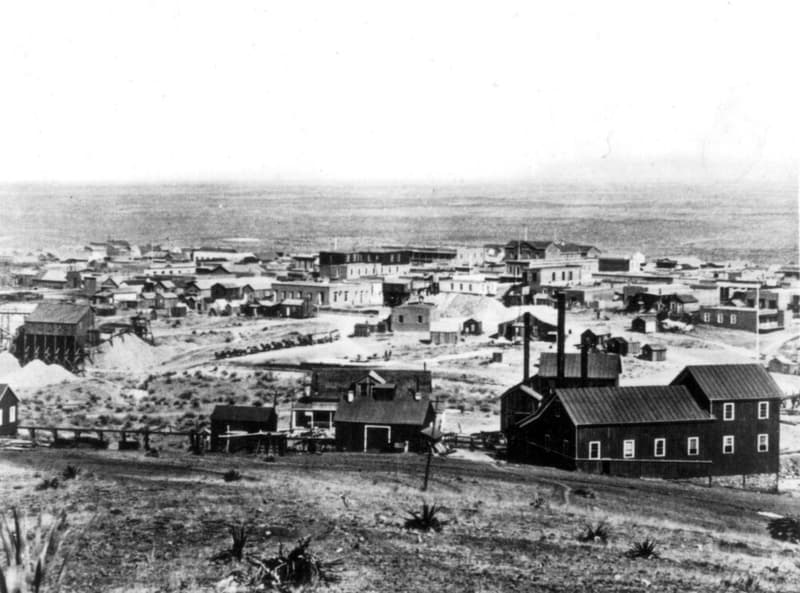
Vogan’s was not one of Tombstone’s swanky saloons like the Oriental or the Alhambra, but it was well attended.
The two Jims worked on two levels. They had a wholesale trade, selling liquor in five-gallon quantities, while the regulars who came for the entertainment bought their drink of choice by the glass in the “sample room.”1
With all the foot traffic, the Daily Nugget commented on October 10, 1880 on the worn floorboards, and noted the improvement when they were covered with “an elegantly patterned oil cloth… [with] strips of matting over it…”6
Some things happened at Vogan’s that wouldn’t have happened in the ritzier clubs. Stray dogs roaming the streets had become a problem in town. One day someone, perhaps some kids up to no good, tied empty tins to a stray dog’s tail and forced it through the front door of the packed saloon. The panicked dog ran wildly through the room, crashing into chairs and card tables.1
The owner’s day off
Jim Vogan owned a horse named Prince, and he entered him in the big Christmas Day trotting race of 1880 at John Doling’s popular Tombstone Driving Park. The winner’s purse was $100, and Wyatt and Virgil Earp were also in the race.3 It was the big event that closed the racing season at Doling’s park.7
Vogan’s becomes a holding cell
Vogan’s played its part in Old West history and legend when a prisoner was held there: Johnny Behind the Deuce.
Michael O’Rourke got the nickname as a gambler. In Charleston on January 14, 1881, he shot and killed Henry Schneider, a popular mining engineer, claiming self-defense. A Charleston mob gathered to lynch him, so Constable George McKelvey put him in a wagon for Tombstone, with vigilantes in pursuit.5
In Tombstone he was placed under guard in Vogan’s Saloon and Bowling Alley, a solid brick building, while Wyatt Earp faced down the crowd. Later that day he was taken on to Tucson to face justice.5
Vogan’s and the 1881 fire
Tombstone’s first devastating fire, in June 1881, damaged Vogan’s. As Clara Brown reported to her San Diego Union readers, “four blocks of frame and adobe buildings were leveled to the ground.”2 Vogan’s was near the worst of it but not in it, and it was quickly repaired.
It reopened four days later with drink specials and a promoted faro game, and even advertised that it hoped to attract a “better, more affluent class” of customers.1 The near miss taught Jim Vogan, like others in town, the importance of fire protection. When Tombstone Fire Engine Company No. 1 was formed that September, he was elected treasurer.3
Trouble at Vogan’s
Vogan’s had its share of drink-fueled arguments that led to gunplay, even though, as you may recall from Tombstone history, a town ordinance early on banned carrying firearms and other weapons without a permit.
In one incident, Charles Daily stepped out the front door and fired off his gun. He was arrested and pleaded not guilty, but the judge didn’t accept his defense and fined him, with court costs, a total of $37.50.1
Another time, the noted gambler Johnny Tyler was at the tables when he suddenly faced off with Tony Kraker. Both drew their guns, and the men around them stepped in before it went further.1
The man killed over his shirt
If you’ve visited Boothill in Tombstone, you may have noticed the grave of the man killed in an argument over his shirt. It’s a true story, but not quite that simple:4
- One day T.J. Waters had a good haul at the gambling tables. He treated himself to a new shirt and wore it around town.
- Some men teased him, and the more it happened, the angrier he got. Finally, in the Alhambra Saloon, he announced that if anyone else said anything about his shirt, he would knock them down.
- His friend Ed Bradshaw hadn’t heard the announcement. Ed came into the Alhambra, saw Waters in his shirt and made a joking remark. Waters punched him and knocked him out, then went into Vogan’s to make the same announcement.
- Ed came to, went home to treat his bruises and got a gun. Back in town he walked into Vogan’s, found Waters and asked why he had attacked him. Apparently not satisfied with the answer, Ed shot and killed T.J. Waters.
- Bradshaw was arrested and held without bail, but was eventually found not guilty.
Vogan’s in more recent times
In the years after its restaurant days, Vogan’s sat closed and dark for a long time. When we last checked in, it had been sold, cleaned up inside, and the plan was to reopen it with wood-fired pizza, something a little different for town. We haven’t been able to confirm whether it has reopened; for places to eat and drink in town now, see our Tombstone restaurants guide.
Our Vogan’s Saloon “incident”
One evening we had been at karaoke at the Crystal Palace, and as we left to head home we noticed the door to Vogan’s standing wide open. It had been closed and dark for ages, so I had to see what was up.
It was 9:30 p.m. I called “helloooo” through the doorway, and someone came to the front. That’s how we met the owner.
Not the new buyer, but the man who had owned it for 37 years, James Ellsberry, a longtime Tombstone resident and a very nice gentleman.
We talked for a while. He told us the sale was in escrow and that the buyer, who lived in Mesa, Arizona, planned to keep the name to reflect the history.
Then we discovered a crazy coincidence. He had once lived in the house we were living in at the time, the fixer-upper we bought when we retired to Tombstone. He lived there for a few years in the early 1980s, and from his description of where it was and how it was laid out, there was no mistaking it was the same house.
References
1 Underhill, L.E. (2012). Tombstone Arizona saloons, 1879-1882. Gilbert, AZ: Roan Horse Press.
2 Bailey, L.R. (1998) Tombstone from a woman’s point of view: The correspondence of Clara Spalding Brown July 7, 1880, to November 14, 1882. Tucson AZ: Westernlore Press.
3 Bailey, L.R. (2004). Too tough to die: The rise, fall and resurrection of a silver camp; 1878 to 1990. Tucson AZ: Westernlore Press.
4 Monahan, S.A. (2007). Tombstone’s Treasure: Silver mines and golden saloons. University of New Mexico Press
5 Guinn, J. (2011). The last gunfight. 24 Words LLC. New York: Simon & Schuster Inc.
6 Jay, R. (2005, Spring). The gambler’s war in Tombstone: Fact or artifact? In Young, R.B., Roberts, G.L. & Tefertiller, C. (Eds.) A Wyatt Earp anthology: Long may his story be told. (pp. 256-285). Denton, TX: University of North Texas Press.
7 Underhill, L. (2016). “IF YOU GO, YOU MUST DRESS UP”: Social Life in a Frontier Mining Town Tombstone, Arizona, 1879-1882. The Journal of Arizona History, 57(3), 281-312. Retrieved from jstor.org/stable/44985594
8 Monahan, S. (2013). Mrs. Earp: The wives and lovers of the Earp brothers. Guilford, CT & Helena MT: Twodot.
No comments yet