
- Virgil Earp’s Early Life and First Marriage
- Virgil Earp’s Post-War Years
- Virgil Earp in Prescott, Arizona
- Virgil Earp in Tombstone
- Virgil Earp and the Gunfight at the O.K. Corral
- Virgil Earp Ambushed: Did He Lose His Arm?
- After Tombstone: Virgil Earp in California
- Cripple Creek and Back to Arizona
- Virgil and Allie in Goldfield, Nevada
- Remembering Virgil Earp
Virgil Earp was the lawman of the Earp brothers. He was Tombstone’s city marshal and a deputy U.S. marshal when he led Wyatt, Morgan and Doc Holliday into the Gunfight at the O.K. Corral in October 1881. Calmer than Wyatt and usually the one who tried reasoning first, he paid for that gunfight with a crippled arm.
His life ran from an Iowa farm to the Civil War, Prescott, Tombstone, California, Colorado and finally a Nevada gold camp. These are the questions readers ask us most:
Virgil Earp’s Early Life and First Marriage
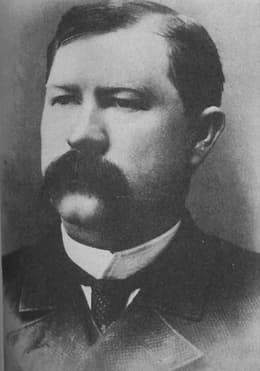
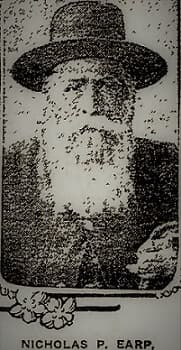
Virgil Walter Earp was born on July 18, 1843, in Hartford, Kentucky, the second child of Nicholas and Virginia Ann (Cooksey) Earp. The family moved to Monmouth, Illinois, and then in 1850 to Pella, Iowa, when Virgil was seven. He spent his childhood on the family farm there.
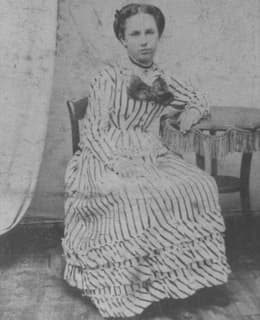
As a teenager in Pella, Virgil met Magdalena C. Rysdam, nicknamed Ellen, a Dutch immigrant from Utrecht in the Netherlands. Born October 25, 1842, she was eight months older than Virgil. The two eloped, possibly to Oskaloosa or Knoxville, Iowa. Our main sources give September 21, 1861, as the date; others place the elopement as early as 1860.1-6
No marriage record survives, so it may never have been legal. There is some evidence they gave the false names Walter Earp and Ellen Donahoo.7
Both sets of parents opposed the union. Ellen’s family wanted her to marry a Dutchman. Nicholas and Virginia Ann Earp felt the two were too young.2 Despite the objections, the couple stayed together for a time.
Virgil Earp in the Civil War
The American Civil War started on April 12, 1861. Virgil’s father Nicholas was a Southern man, but he was against slavery and didn’t believe in secession. He sided with the Union as a provost marshal, finding and drilling local recruits.
Virgil had to wait until he was 18 to enlist in the Union Army. His older brothers Newton and James had already joined. So he left his young family to serve the Northern cause.
Virgil Earp Has a Daughter
On January 7, 1862, Virgil and Ellen had a baby girl, Nellie Jane.3 She was still an infant when Virgil left with the Illinois Volunteer Infantry in 1862.
Virgil Earp’s Description in Military Records
Virgil signed up for three years. His military record lists his height as 5 feet 10 inches, with fair skin, fair hair and blue eyes. His occupation was farmer. Interestingly, he was listed as unmarried.7 His company was stationed mostly in Tennessee. Virgil’s service wasn’t remarkable or heroic, and he stayed a private.
One incident led to a court-martial: military property was lost while in his care.11 His sentence was the loss of two weeks’ pay. He served out his three years and was honorably discharged.4
About midway through Virgil’s service, a rumor reached home that he had been killed. Ellen believed she was now a war widow. She likely felt it would be hard on her own with a child. Her father, and Virgil’s father too, probably preferred that she believe the hearsay.
In early 1864 Ellen married a Dutch immigrant, John Van Rossem. Soon afterwards they joined a wagon train bound for the Pacific Northwest. Many Dutch immigrants headed that way to get away from the war and the draft. John was a leader on the nearly 2,000-mile trip, and Ellen drove a wagon over the Oregon Trail. They reached Oregon City six months and many dangers later.5 Van Rossem died soon afterwards, and in 1867 Ellen married Thomas Eaton in Walla Walla, Washington Territory.1

Virgil Earp’s Post-War Years
Virgil received his army discharge on June 26, 1865, and returned to Pella to reunite with his family. But they were gone. He probably heard why Ellen had left, and he didn’t pursue her. His own family had also gone by wagon train, to San Bernardino, California, in 1864. Nicholas Earp rented a farm there on the Santa Ana River.
Virgil rejoined his parents and siblings. He noticed that his younger brother Wyatt was restless and disliked farm work. He took Wyatt along, and they both began teamster work.8
Virgil drove the stagecoach. He taught 17-year-old Wyatt the business as a helper, a “swamper.” Wyatt rode the shotgun seat, helped with loads and spelled Virgil at the reins. Their route ran from Los Angeles to Prescott, Arizona, and sometimes to Salt Lake City.7 Later they worked on railroad construction in Wyoming.
At some point Virgil and Wyatt went their separate ways. Wyatt continued his own adventures. Virgil went back to Pella for a while and worked several jobs.
A Second Marriage in Lamar, Missouri
Farming wasn’t working out, and none of the sons liked it. In 1868 Nicholas moved the family again, to Lamar, Missouri, where he became justice of the peace.
Virgil joined them. On May 30, 1870, Nicholas married Virgil to Rosella Dragoo, a 17-year-old French immigrant.1 After that there is no further word of Rosella. Perhaps her parents objected and the marriage was annulled, or perhaps she died of one of the illnesses of the day. No records tell.
Allie Sullivan, Virgil’s Lifelong Companion
In the 1870s Virgil left Lamar and ended up in Council Bluffs, Iowa. There he met a waitress, Alvira Packingham Sullivan, called “Allie.” They stayed together for the rest of his life, although no record of a marriage has ever been found.
Allie was born in 1849 in Florence, Nebraska, so she was in her mid-twenties when Virgil came to town. Soon they were traveling together.11
By mid-1876 they were in Dodge City, Kansas, where Wyatt Earp was assistant marshal. The Earp brothers often tried to stay near each other. Allie later said Virgil was briefly deputized by Wyatt there, although no record of it survives.
Virgil Earp in Prescott, Arizona
Virgil and Allie moved to the Prescott area of Arizona Territory in July 1877.9 He worked various jobs there, first as a mail carrier and then in a sawmill. Within months an incident made him a lawman on the spot.
The Prescott Gunfight of October 1877
Prescott’s newspaper, the Weekly Arizona Miner, reported the fight on October 19, 1877. Virgil was on the street with the sheriff and a U.S. marshal. Two outlaws, wanted for murder elsewhere, were in the Jackson & Tompkins Saloon at 134 Montezuma Street, abusing customers and shooting at a dog. Prescott Constable Frank Murray came in and ordered them out of town.17
The two rode through the streets firing their pistols “to the right and left,” just as bad guys do in the Westerns. The constable got Sheriff Ed Bowers, Marshal Wiley Standefer and Virgil, “Mr. Earb” [sic], to help. Virgil didn’t even own a horse at the time, so he tracked them on foot, carrying his Winchester rifle.17
The posse cornered the outlaws at Granite Creek and shot both. The one named Tullos was killed. The other, Wilson, alias Vaughn, was shot in the head and died soon afterwards.17 A jury found the lawmen had acted in the “proper discharge of their duty.”10
Night Watchman and Constable
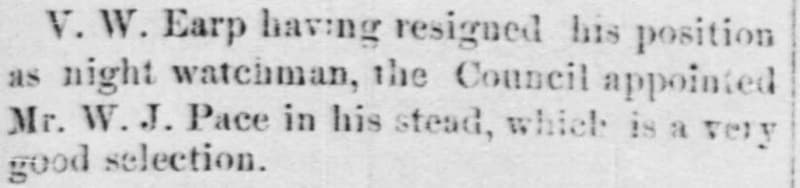
The fight made Virgil well known in Prescott. In early March 1878 the village council gave him a post close to law enforcement: night watchman.
Patterson, Caldwell & Levally, a Prescott freight company, also hired him as a driver. Among his passengers were the territorial secretary, John J. Gosper, and Crawley P. Dake.11 These lucky meetings eventually brought him to Tombstone.
On November 1, 1878, Virgil announced his candidacy for Prescott village constable, with the backing of the Weekly Arizona Miner. The results were published on November 8: Virgil won by just over 100 votes. He resigned as night watchman, and he and Allie seemed settled in Prescott.

The Earp Brothers Plan for Tombstone
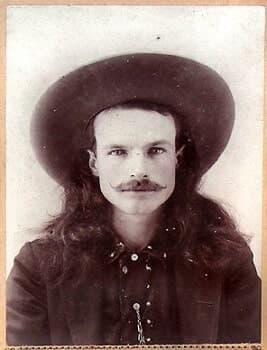
At the end of 1878 Virgil’s brothers were scattered around the West. They wrote to each other into 1879, weighing their options. Virgil had noticed the silver discovery at Tombstone, a new southern Arizona town on the move.
Crawley P. Dake was the U.S. marshal for Arizona Territory. Stage robberies in southern Arizona were a problem, and Dake wasn’t getting the federal help he asked for. So he began doing things his own way. In the autumn of 1879 he offered Virgil the job of deputy United States marshal.12
Virgil was ready for the move, even if Allie wasn’t quite. Prescott’s Arizona Weekly Miner also reported some bothersome issues:
- On June 25, 1879, Virgil faced a grand jury investigation of charges brought by a man named Roggen. They were dismissed in November.
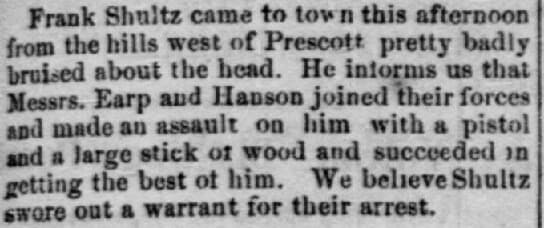
- On October 3, 1879, Frank Schultz accused Virgil of assault.
Virgil told his brothers he was moving to Tombstone. James and his wife Bessie came to Virgil’s home that autumn, followed by Wyatt with Mattie Blaylock and Doc Holliday with Big Nose Kate. All the brothers looked forward to new opportunities in Tombstone.
Virgil accepted the post of deputy U.S. marshal on November 27, 1879. In an interview he said, “I went from Prescott to Tombstone as Deputy United States Marshal.”9 The Earp group left Prescott and arrived in Tombstone in early December. Doc Holliday and Big Nose Kate stayed behind for Prescott’s gambling.
Virgil Earp in Tombstone
Virgil and Allie found a house on the southwest corner of Fremont and First Streets. Wyatt’s house was next to theirs, slightly west. Virgil busied himself getting settled in town.
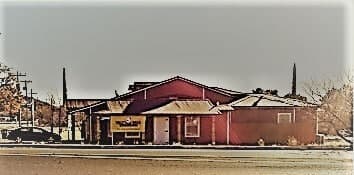
Virgil and Allie’s original house burned down. The Corner B&B that stands on their lot today is said to incorporate some reclaimed wood from it. See our guide to Tombstone bed and breakfasts for more places to stay.
Deputy U.S. Marshal
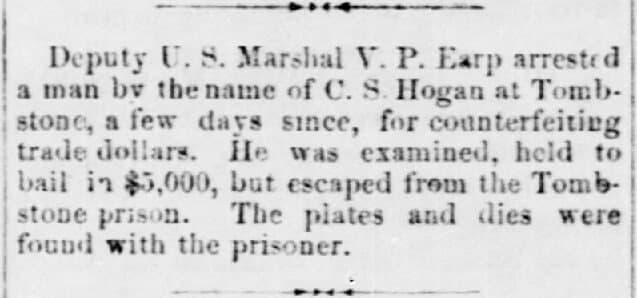
Virgil had plenty of tasks as deputy U.S. marshal. In July 1880, for instance, an anti-Chinese mob roamed the town, and he warned Dake of a possible riot.16
Dake asked him to deal with the marauding Cochise County Cow-boys. In the late 1800s “cow-boy” meant a ranch hand roaming the range. These men grabbed cattle in the border country and were accused of changing the brands and selling them. Virgil expected to solve the problem.
Tombstone City Marshal
The federal job didn’t pay well, and Virgil worked on and off helping county and city officials. An incident in late October 1880 gave him a chance at more.
City Marshal Fred White was shot by Curly Bill Brocius. Before he died of the gut wound a few days later, White said the shooting was accidental.
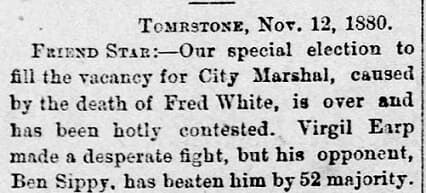
Virgil was immediately appointed acting city marshal, a much better paying job.13 He decided to run for the office in the special election on November 13, 1880. His opponent, Ben Sippy, won by 52 votes.
Seven months later Sippy asked for a leave of absence and never returned, leaving questionable finances behind. Virgil was again appointed acting city marshal.
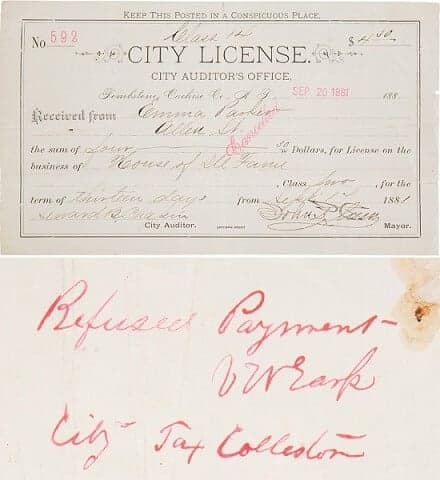
Then, on June 22, 1881, a fire destroyed much of Tombstone’s business district. Virgil’s popularity soared as he patrolled the streets with his Winchester and kept lot jumpers from taking land illegally. On June 28, 1881, Mayor John Clum made him Tombstone’s permanent city marshal, the chief of police. The pay was now a reliable $150 a month.11
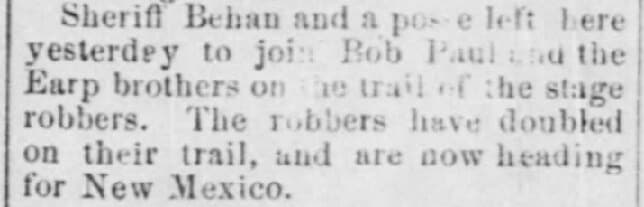
As deputy U.S. marshal, Virgil also investigated stage robberies. In one, on March 15, 1881, the driver, Bud Philpot, and a passenger were shot dead.
The suspects were cow-boys. Virgil gathered a posse that included his brothers and Doc Holliday. They found clues and went after the robbers, but they never made an arrest that stuck.11
Trouble With the Cow-boys
In April 1881 the city fathers passed an ordinance banning deadly weapons in town, except for lawmen. As written it was confusing and hard to enforce, and it wasn’t popular. It was one cause of the bad blood between the Earps and the Cow-boys.
Virgil said his first dealings with the Cow-boys came “when they stole a band of government mules from Camp Ruckner” [sic]. He took a posse to the McLaury ranch and saw the suspected mules there. Tense words were exchanged, but no arrests were made.9 The old army post is now the Camp Rucker Historic Site in the Chiricahua Mountains.
In town, the Cow-boys often ran into trouble with the law. They blew off steam and drank heavily, which irritated citizens and lawmen alike. The Earps and the Cow-boys got to know each other well. By late October 1881 the friction was headed for a deadly showdown.
Virgil Earp and the Gunfight at the O.K. Corral
Cow-boys Tom McLaury and Ike Clanton came into town on Tuesday, October 25, 1881, to run errands. They planned to eat, gamble, drink and stay overnight, and took a room at the Grand Hotel.
Ike had been around town airing his dislike of the Earps, and that day was no different. The more he drank, the louder his complaints.
That evening Ike was eating at a saloon when Wyatt, Morgan and Virgil Earp and Doc Holliday came in. Doc started arguing with Ike, and the Earps broke it up. Wyatt walked Doc to his room at Fly’s photography studio.
Then an odd group sat down to poker: Ike Clanton, Virgil Earp, Tom McLaury, John Behan and one other man. They played until about 7 a.m. As Virgil left, Ike told him Doc was going to have to fight.
Virgil always tried to calm things down and reason first.11 Ike was still angry and said he aimed to kill Doc Holliday. Virgil took it for drunk talk. He told Ike to go home and sleep it off, and said he didn’t want to hear any more talk like that, since he was the law.
Ike didn’t stop. He went around town threatening the Earps and Doc Holliday, and plenty of townsfolk heard him.
When Virgil woke up, friends told him what Ike had been doing. He felt he had to find Ike, make sure he wasn’t armed, and disarm him if needed.
Eventually Virgil, Wyatt, Morgan and Doc met the Clantons and McLaury brothers in a narrow lot near the O.K. Corral. Who started the shooting is still disputed.
It was over very quickly. Ike Clanton ran off unharmed, but his brother Billy and both McLaurys were dead. Wyatt wasn’t hit and Doc Holliday was barely grazed. Morgan was shot across the shoulders, and Virgil was shot through the calf. In less than a minute three men were dead and three were wounded. We tell the whole story in our article on the Gunfight at the O.K. Corral.
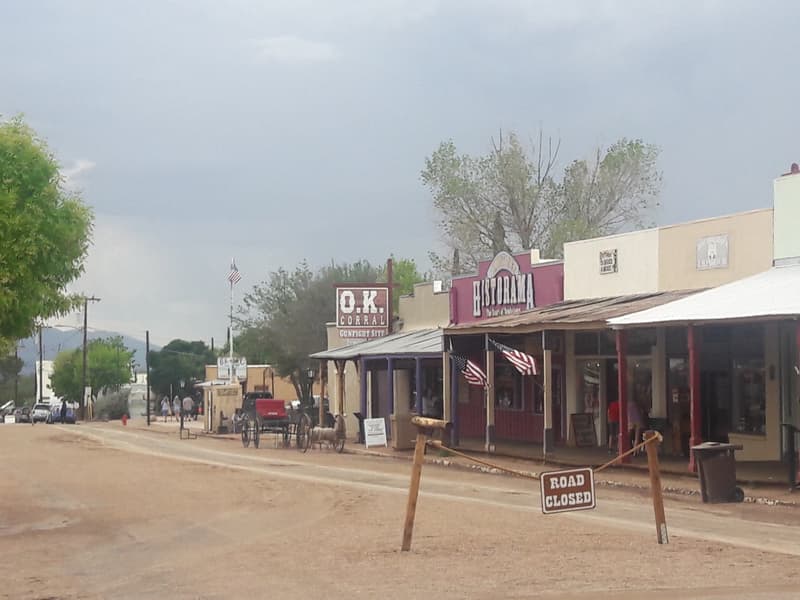
Sam Elliott as Virgil Earp in the Movie Tombstone
In the 1993 film Tombstone, Virgil was played by Sam Elliott, with Kurt Russell as Wyatt.
Were the Earps Charged With Murder?

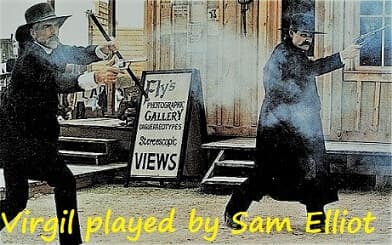
Tombstone split over who was at fault. About 300 people walked in the funeral procession for the three Cow-boys, behind the Tombstone Brass Band, and as many as 2,000 watched from the sidewalks. A sign proclaimed: “Murdered in the Streets of Tombstone.” The three were buried at Boot Hill.11
While Virgil recuperated, Ike Clanton filed murder charges against him, Wyatt, Morgan and Doc. Wyatt and Doc were jailed for a time, and Virgil was suspended as police chief. After a hearing, Judge Wells Spicer found that the Earps and Holliday had acted within the law. A grand jury reached a similar outcome, and the charges were dropped.
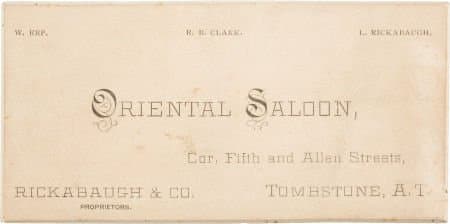
Judge Spicer received an anonymous threatening letter and answered it in the Tombstone Epitaph. Then someone shot at the Epitaph’s editor, John Clum.
Virgil also got into a heated argument in the Oriental Saloon with its manager, Milt Joyce. Joyce had worked with the Earps before, especially Wyatt, but he definitely didn’t like Doc Holliday, and lately there had been friction.
Joyce accused Virgil of being behind the attack on Clum. Virgil slapped him. Joyce backed out of the barroom, saying sarcastically that he didn’t want to end up the usual Earp way: shot in the back.11
Virgil Earp Ambushed: Did He Lose His Arm?
The Earps knew feeling against them in town had grown, and so had the danger. They moved their families into the Cosmopolitan Hotel.
Late on the night of December 28, 1881, Virgil was walking on Allen Street between the Oriental and the Crystal Palace saloons. Shotgun blasts came from the second story of a building under construction across the street. The building later became known as the Bucket of Blood Saloon, and the Longhorn Restaurant stands on the corner today. The gunmen got away.
No, Virgil did not lose his arm. The buckshot shattered his left arm, but it wasn’t amputated. Dr. George Goodfellow removed several inches of bone and the elbow joint, and the arm was close to useless for the rest of his life.
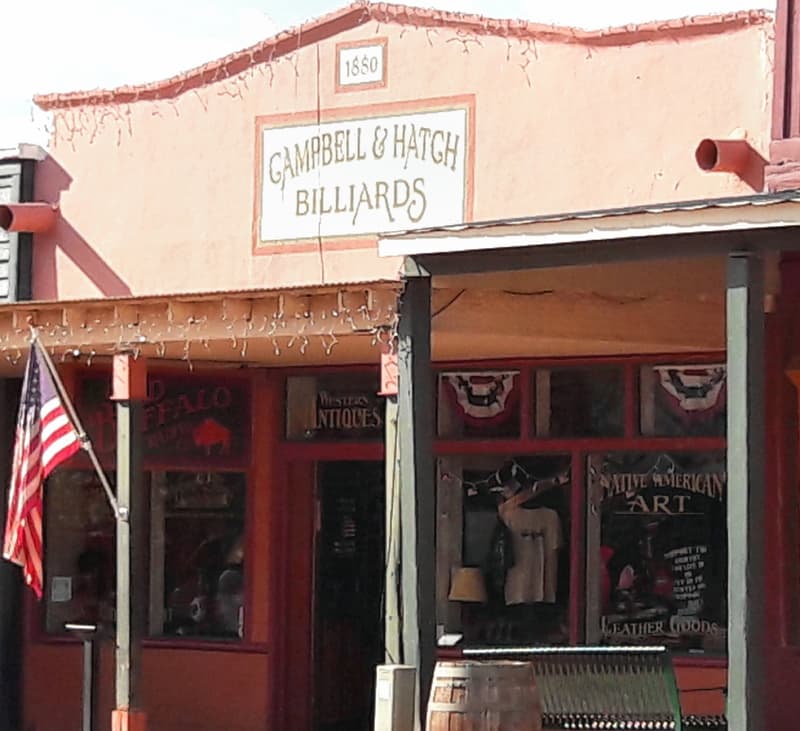
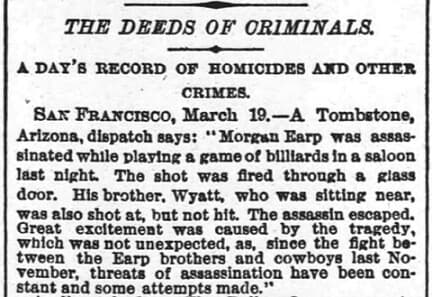
On March 18, 1882, Morgan and Wyatt Earp were playing pool at Campbell & Hatch’s on Allen Street. Two bullets came through the back door from an alley. The first hit Morgan and was fatal. The second came close to Wyatt’s head. Morgan died a little later with family at his side.
After Tombstone: Virgil Earp in California
Morgan’s body was shipped to Colton, California, and Virgil and Allie took the train there too. They stayed with the family in Colton while Virgil had his arm treated. For two years he traveled to San Francisco for specialized medical care.11
Colton
Virgil took a job as a private guard for the Southern Pacific Railroad, which was fighting a division of the Atchison, Topeka and Santa Fe over territory. With his gun ready in the engineer’s cab, he was to stop the competitor from laying track forward until the courts ruled.1
In early 1886 he opened a detective agency. He also gambled.1 He and Allie moved into their own home on West H Street, which still stands.11
His father Nicholas was well known in Colton, where he ran the Gem Saloon and was elected justice of the peace in 1884.11 With the Earp name behind him, Virgil was elected village constable in July 1886 and closed the detective agency. When Colton incorporated as a city the next year, he was elected its first city marshal.1
The job soon proved to be less than he expected. It paid $75 a month, and Virgil mostly dealt with drunks and vagrants. He paid for repairs and materials out of his own pocket, and he even had to dig out and clear the jail’s sewer line. He resigned in March 1889.1
Moving Around California
To earn a living, Virgil started arranging boxing matches in San Bernardino, something he had done a bit of in his early days.11 He applied for a pension for his injuries and, once it was approved, received $12 a month. For steady work, he managed a gambling hall in 1890.11
Next they moved to San Luis Obispo. Virgil and Allie followed horse racing, and he started betting at the track there.11 It wasn’t as good as they hoped, so they moved on.
In April 1893 they went to Vanderbilt, California,11 a gold camp near the Nevada line. Virgil opened a saloon called Earp’s Hall. Upstairs was a large room used for dances, boxing matches and Sunday church services. People liked his quiet, friendly manner. Even so, when he ran for constable in 1894, he lost.1
Cripple Creek and Back to Arizona
Wyatt and his wife Josie had gone to the gold-mining town of Cripple Creek, Colorado. Virgil and Allie went to join them, planning to open a saloon.
But Cripple Creek was already booming and had countless saloons. It didn’t need another one.11 Virgil soon realized this, and he and Allie moved back to Arizona, where they remembered being happy.
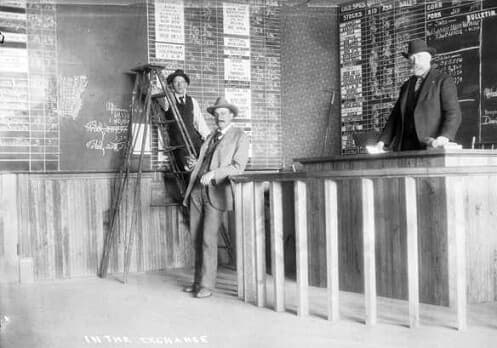
They returned to where they had first lived in the territory, Prescott, and settled on a ranch in the Kirkland Valley south of town.1 Virgil also tried mining.
He and W.H. Harlon leased the Grizzly Mine. On November 7, 1896, while they were working for gold ore, the tunnel caved in. Virgil was knocked out by falling rock and dirt. He suffered a dislocated hip, bruises, cuts and a bleeding head wound, and needed crutches for a while.11
While he recovered, he concentrated on the ranch. He also helped with Prescott’s law work and was deputized when needed.11
Virgil Earp Discovers His Descendants
In late 1898 a woman in Oregon mailed Virgil a letter. She had read a newspaper account of the O.K. Corral shootout that mentioned where Virgil was living.
The letter was from Mrs. Levi Law. She asked whether he was the Virgil Earp who had married Ellen Rysdam in Iowa in 1861. If so, she wrote, she was Nellie Jane, his grown daughter.1
Virgil and Allie were amazed and thrilled, and they began writing to her. Nellie Jane planned to visit them in Arizona, but she canceled the trip when her daughter caught pneumonia.
Instead, in April 1899 Virgil traveled to Portland, Oregon, and stayed two weeks with his daughter and granddaughter.14 Ellen was there too. Virgil discovered he had two other grandchildren, and a great-grandchild on the way.11 The following winter Nellie Jane visited Arizona.1
Ranch Life Loses Its Appeal
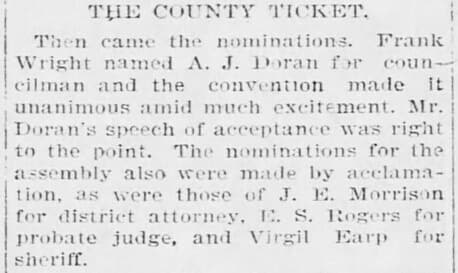
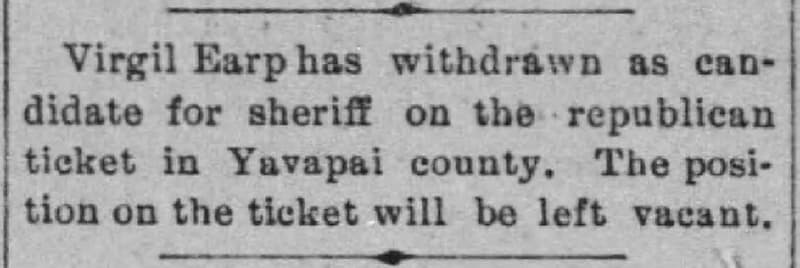
Virgil was still popular enough in Prescott to be nominated for sheriff in 1900, as the Republican candidate for Yavapai County. Before the election, he withdrew.1
Virgil often went back to Colton to visit family. In 1902 he began selling his livestock and his Prescott properties,11 thinking of a return to Colton.
Colton was a small town with an ordinance that allowed only one saloon. Virgil joined a petition to repeal it, and the churches opposed it. The council did change the law, but the replacement allowed just two saloons, and the second license went to T.J. Tuschman.1 That didn’t fit Virgil’s plans, and it wasn’t worth another battle. Instead, he and Allie moved to Goldfield, Nevada, in 1904.11
Virgil and Allie in Goldfield, Nevada
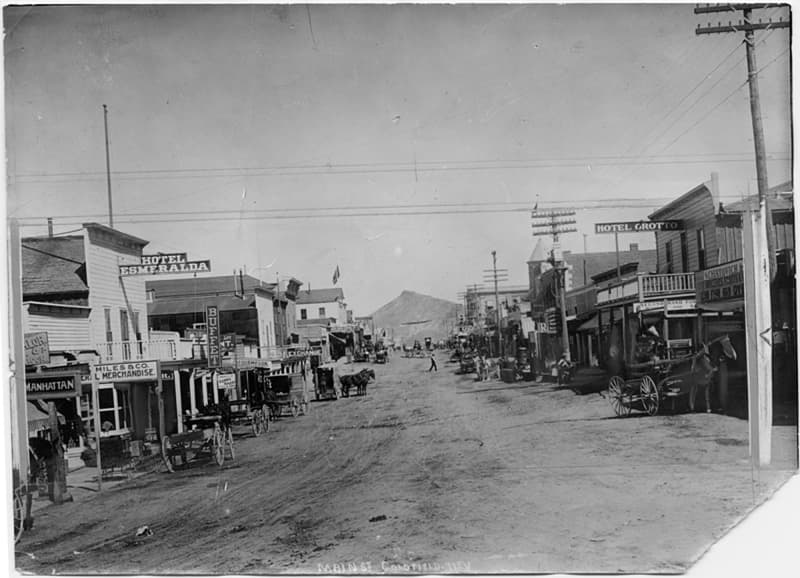
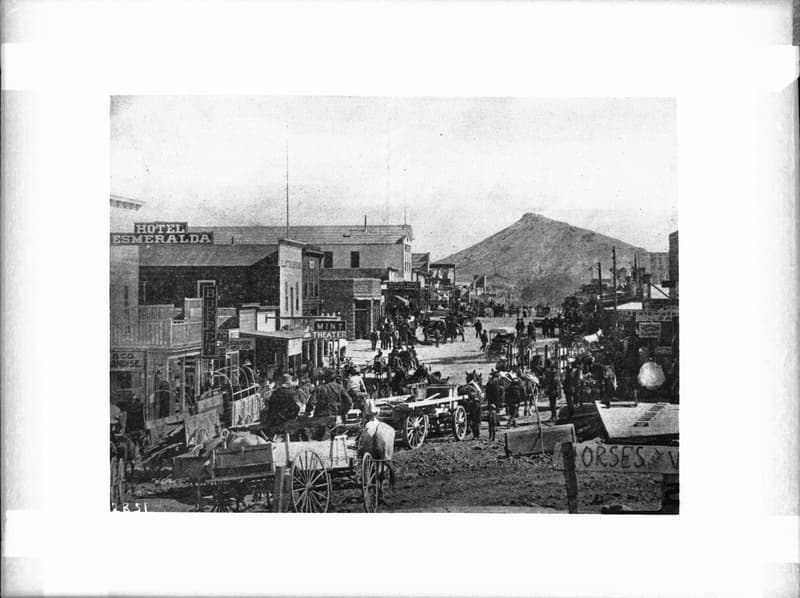
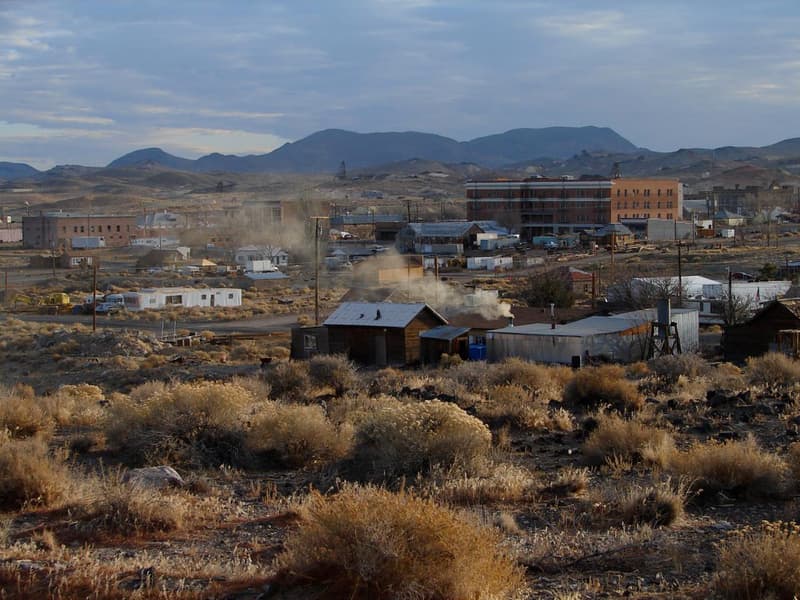
Why Goldfield? It was a new, booming gold-mining town. At this stage of life Virgil was in no shape to go mining, and he had little money to invest in a business. He had his reliable pension, and Allie could earn money sewing.
He found work as an enforcer, which some called a special officer, at a local casino, the National Club.11 It was probably closer to a bouncer’s job, and only loosely related to his past as a lawman. Then again, he was past his prime and carrying old injuries, and it was a small area to cover.
His experience still counted, though, and he soon returned to real law enforcement. On January 26, 1905, he became a deputy sheriff of Esmeralda County under Sheriff J.F. Bradley.11
How Did Virgil Earp Die?
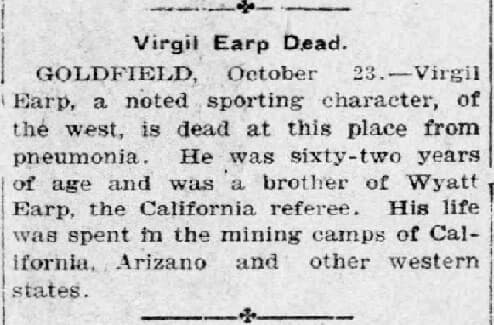
Within a few months of becoming a deputy, Virgil fell ill with pneumonia. He fought it with the treatments of the time and seemed better for a while, but then he relapsed. By October 1905 it was serious, and he went into St. Mary’s County Hospital on Euclid Avenue in Goldfield.15
He died there on October 19, 1905, at the age of 62.11 Allie was at his side, holding his hand in his last moments.15
Allie telegraphed Virgil’s daughter, Nellie Jane, that her father had died. She advised her to act fast if she wanted him, because Wyatt would claim the body.
Virgil Earp’s Grave
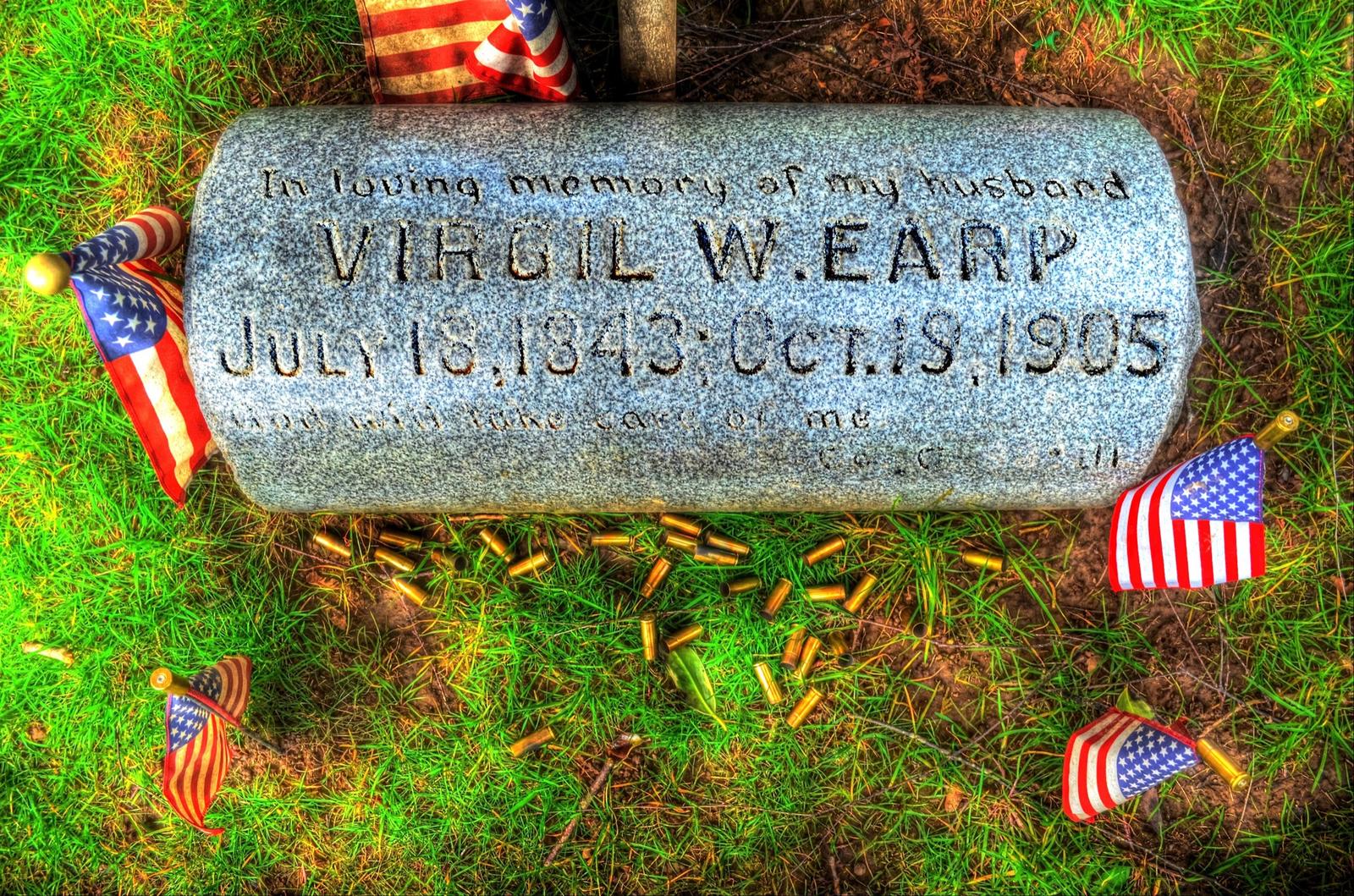
Alex Bertrand, the husband of Nellie Jane’s daughter Maud, went to Goldfield on her behalf to bring Virgil’s coffin back. Virgil was buried in the Bertrand family plot in River View Cemetery in Portland, Oregon, a nonprofit cemetery founded in 1882.1, 14
Several Earps settled in Colton, California, and Morgan is buried there. Because of his daughter, Virgil didn’t spend eternity in Colton. If you visit Portland, you can see his grave.
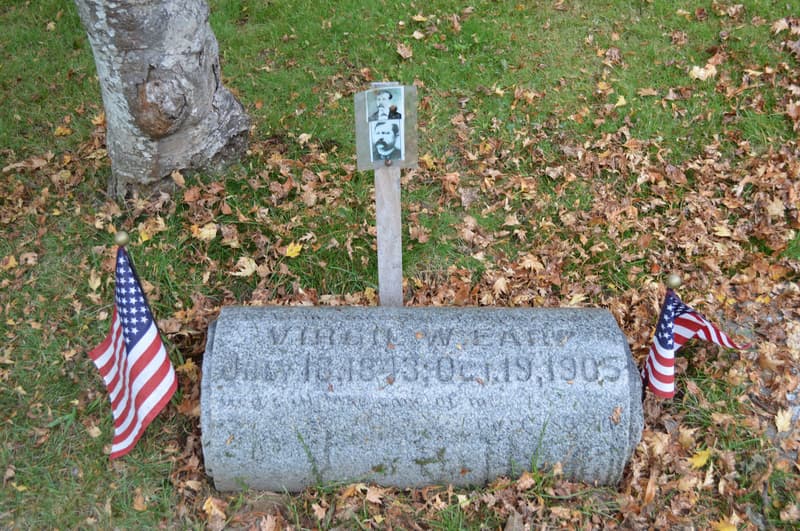
Allie lived another 42 years. She died in Los Angeles in 1947, at the age of 98.11
Remembering Virgil Earp
As a lawman, Virgil Earp usually tried reason first, used force only when necessary, and turned to deadly action as a last resort. Over the years, people who knew him mostly had kind or admiring things to say about him. Around Tombstone, though, many held bitter opinions of the Earps, Virgil included.
It’s hard to judge someone who has been dead this long, and there are always two sides to a story. Virgil surely had his faults. Still, he was probably trying to do his best in law enforcement. Everyone who studies his story will reach their own conclusions.
References
1 Paul, J.S. & Carlisle, G. (2002, February). Frontier lawman Virgil Earp. Wild West. Retrieved from historynet.com/frontier-lawman-virgil-earp.htm
2 Simkin, J. (2014, August). Virgil Earp. Spartacus Educational Ltd. Retrieved from spartacus-educational.com/WWearpV.htm
3 Friedman, R. (1997). Tracking down Oregon. Caldwell, ID: The Caxton Printers Ltd.
4 Ganstra, P. (2010, July 25). Earps were shooting long before the OK corral. Civil War Primer retrieved from civilwarprimer.com/2010/07/earps-were-shooting-long-before-the-ok-corral/
5 Beltman, B.W. (December 1997). Nineteenth century Dutch migrants extraordinaire on the prairie-plains. Retrieved from aadas.nl/sites/default/files/proceedings/1997_12_Beltman.pdf
6 Hopper, P. (n.d.). Of Roseville, CA. Via San Bernardino County Archives. 777 East Rialto Ave, San Bernardino, CA
7 Clavin, T. (2017). Dodge City: Wyatt Earp, Bat Masterson, and the wickedest town in the American West. New York: St. Martin’s Press.
8 Cataldo, N.R. (n.d.). The Earp clan: The Southern California years. As re-edited on the City of San Bernardino History Index page: Wyatt Earp in San Bernardino. Retrieved from www.ci.san-bernardino.ca.us/about/history/wyatt_earp.asp
9 Palmquist, R.F. (1982, May). Arizona affairs: An interview with Virgil Earp. Real West Magazine. Retrieved from web.archive.org/web/20090423122018/….angelfire.com/co4/earpgang/interviewtwo.html
10 The Weekly Arizona Miner (Friday, 19 October, 1877). The victims of their own folly. Prescott, Arizona. Retrieved from newspapers.com/image/49592834
11 Charles River Editors (n.d.) Legends of the West: Virgil Earp and Morgan Earp. Harvard and MIT Alumni.
12 Ball, L. D. (Autumn 1973). Pioneer Lawman: Crawley P. Dake and law enforcement on the Southwestern frontier. The Journal of Arizona History. Arizona Historical Society. 14 (3), pp 243–256. JSTOR 41695121.
13 Marks, P. M. (1996). And die in the West: The story of O.K. Corral gunfight. Norman, OK: University of Oklahoma Press. ISBN 978-0-8061-2888-7.
14 John, F.J.D. (2010, September 27). Why legendary Old West lawman Virgil Earp is buried in Oregon. Offbeat Oregon History. Retrieved at offbeatoregon.com/H1009d_virgil-earp-buried-in-portland.html
15 Goldfield Historic Walking Tour Booklet (2013, August). The Goldfield Historical Society, a 501c.3 Non Profit organization. 4th Edition. Retrieved from goldfieldhistoricalsociety.com/Goldfield_2013_Booklet_Web.pdf
16 The Weekly Arizona Miner (1880, July 30). The Chinese Must Go, p3; Prescott AZ.
17 Williams, R. & Courtney, B. (2019, March 7). Event Lecture: Virgil Earp: Toughest of the Earps? Schieffelin Hall, Tombstone AZ.
No comments yet