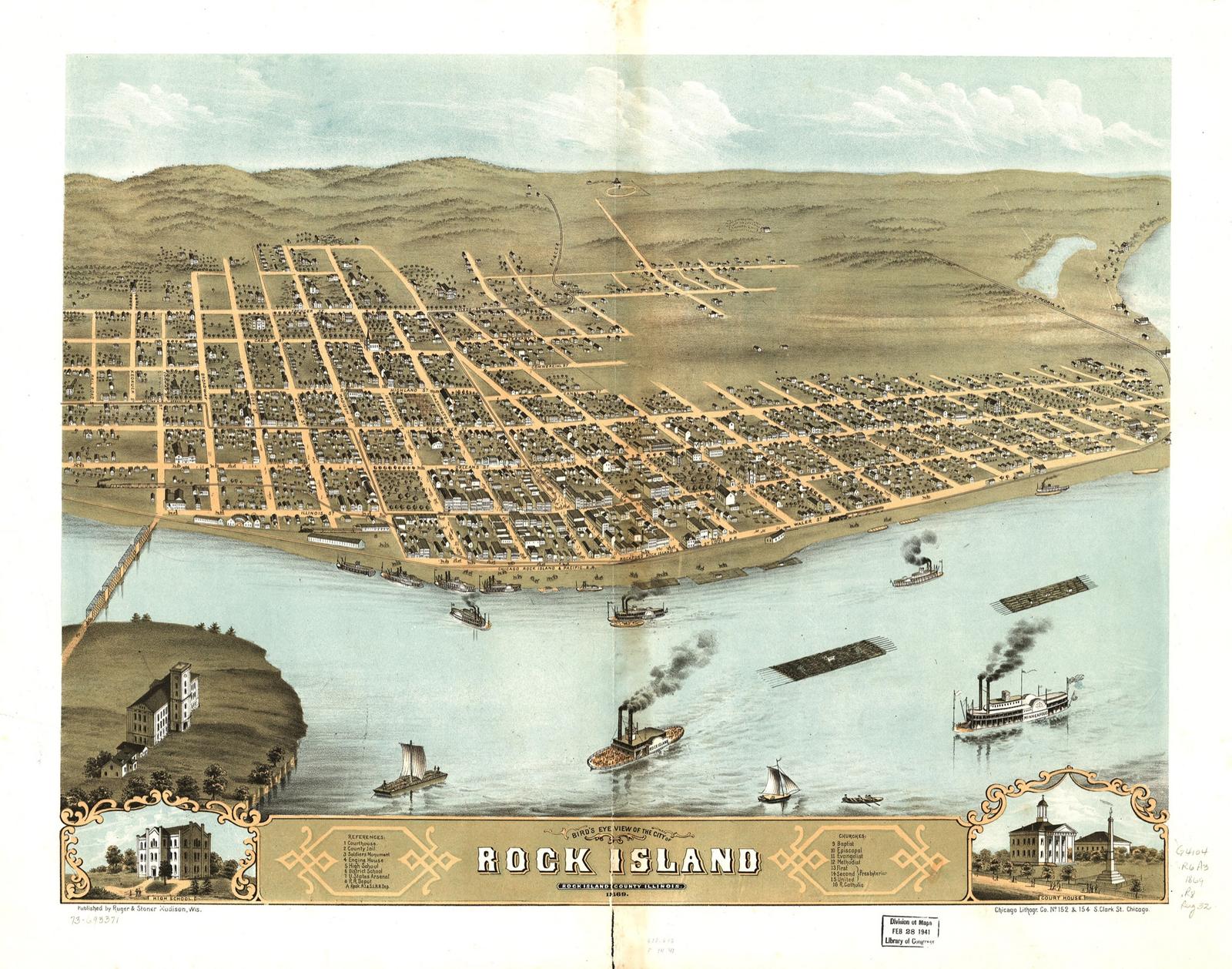
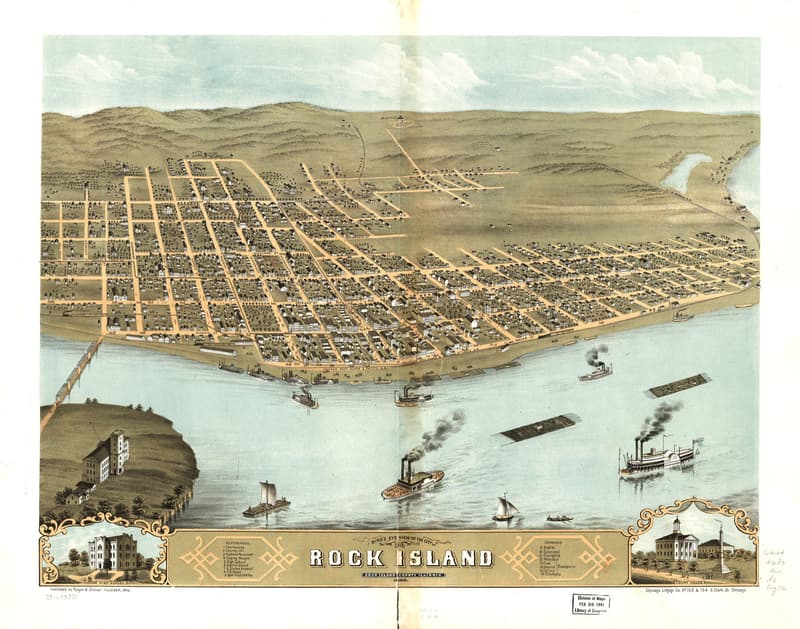
Sherman McMaster’s origins were not in Tombstone, Arizona. He was born in Galena, Illinois, in 1853 and raised in Rock Island, Illinois. His father was a business owner, and Sherman did not want for anything in his youth. He had a good education1 through high school.3 Was it then he learned to speak fluent Spanish?1 When he was old enough to leave home, sometime between 1870 and 1878, he went West.3
He was in Dodge City, Kansas, sometime between 1876 and 1878. It has been reported that McMaster shot a man in self-defense while in Dodge. Wyatt Earp was there at the time, as was Doc Holliday. This is when he first made their acquaintance.
Working as a Lawman
By August of 1878 he was in El Paso, Texas.3 Until the spring of the next year, McMaster worked as a Texas Ranger and as a scout for the 9th Cavalry. He was fast and accurate with firearms.1 That likely impressed the Rangers into hiring him.
During this stint he met Curly Bill Brocius. Curly Bill was held by the Rangers there for a government wagon hold-up. He escaped, under suspicious circumstances, in November of 1878, and next surfaced in southeastern Arizona.
It has been thought that Sherman McMaster aided his escape. The two had struck up a friendship, and that brought suspicion McMaster’s way.
Next: New Mexico
After leaving the Texas Rangers, Sherman McMasters turned up in northern New Mexico, in Las Vegas. There McMaster got in with Hoodoo Brown. Hoodoo became a corrupt town leader, serving as Justice of the Peace, Mayor and Coroner. He recruited others from Kansas, and they all became known as the “Dodge City Gang.”
Some sources say McMaster went to Arkansas after that, but the documentation for that is quite sketchy.
Back on the Wrong Side of the Law in Arizona
By the summer of 1880, Sherman McMaster was in Arizona. He was in contact with Curly Bill again, which is probably how he was introduced to Johnny Ringo.
Through Curly Bill he soon met Pony Diehl and Johnny Barnes, both men known to the Clantons. So now Sherman McMaster was associated with the Cochise County Cowboys, those locally known “trouble-makers.”
At some early point McMaster was also introduced to Wyatt Earp. Wyatt seemed to understand something of Sherman’s psyche: his involvement in the Cow-boy lifestyle, with an underlying sense of justice. Wyatt was able to get Sherman McMasters to give him inside information, to be an “informer,” so to speak.4,6
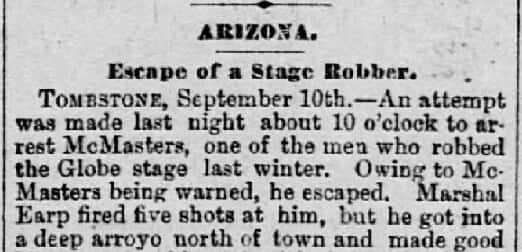
Yet it wasn’t long before McMasters apparently got involved in a few robberies. One may have been the government mule rustle out of Camp Rucker.4 At least once, he collaborated with Ringo. According to one source (one known to make errors of detail), Sherman was accused of a stage robbery near Globe, Arizona.2,6
When McMasters was spotted by Virgil in Tombstone, Virgil reported it to his superior. Before Virgil had a chance to act, McMasters apparently went to the Contention Mine. The mine’s general manager, E.B. Gage, had his high-quality horse hitched there. It disappeared. Sherman was accused of stealing it; rumor was that he traded it off. Rumor also had it that Virgil didn’t follow up.2
Sherman McMasters’ Divided Loyalties
On the one hand, Sherman McMaster had a solid friendship with Curly Bill Brocius, a man with a lawless past.
On the other hand, he had also met Wyatt Earp, and likely Virgil, and had developed a friendship with them. He probably knew Doc Holliday too. Because Doc was Wyatt’s friend, McMaster would have treated him cordially.
That made for some awkward situations. He had been acting as an informant for Wyatt Earp, offering details about Cowboy activities that Wyatt could not have gotten otherwise. After the Gunfight at the O.K. Corral in October 1881, the Cowboy contingent would expect him to take up their side. So what did he do?
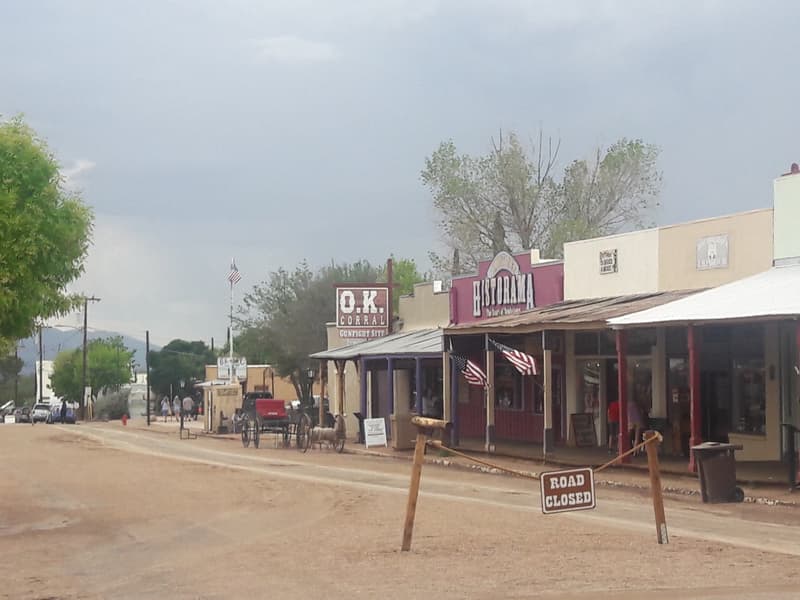
McMaster Chooses the Law, for the Earps
Just after Christmas 1881, Virgil Earp survived an attempt on his life on Allen Street. His arm was damaged for life. Sherman McMasters was still running with the Cowboy crowd enough to chance on a key conversation. The Clantons were among the prime suspects in Virgil’s attack.
Judge William Stilwell called Ike Clanton for a preliminary hearing to evaluate the evidence. McMasters testified that he was nearby when Ike grumbled that Virgil remained alive, saying he would “have to go back and do the job over,” which seems self-incriminating.5,6 But the sum total of evidence wasn’t enough to stick. Multiple witnesses placed Ike in Charleston at the time of the shooting.6
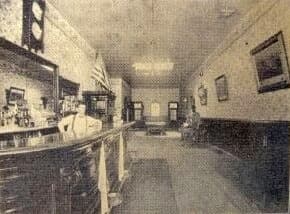
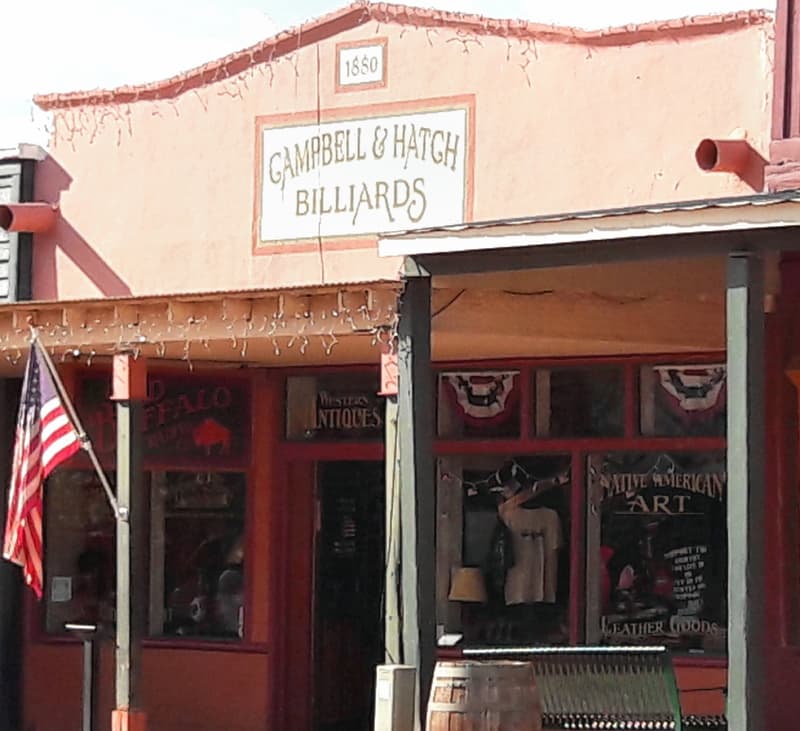
In March 1882, Morgan Earp was gunned down by an assassin at the rear of Campbell & Hatch’s Saloon. Sherman McMaster was right there, talking with Wyatt, while Morgan played pool with the owner, Bob Hatch. Sherman witnessed Morgan’s shooting as the gunfire came through the back of the saloon. Hatch and McMasters dashed through the back door into the alley, attempting to find the assassins.6 They were gone.
Within the hour, Morgan was dead.6 Wyatt was full of raging vengeance.
Wyatt’s Vendetta
Wyatt Earp organized a posse to find those responsible, especially for Morgan’s murder, but also for Virgil’s attack. It’s known as Wyatt’s Vendetta Ride. He asked Sherman McMaster to come along, and made him a federal deputy.1
On Monday, March 20, 1882, Sherman was with Wyatt and Warren Earp. Also recruited were Doc Holliday and Turkey Creek Jack Johnson. Their purpose was to accompany Virgil and Allie Earp, standing guard as they traveled to Contention to get the train to Tucson. Word was that cowboys were planning an attack in Tucson.6
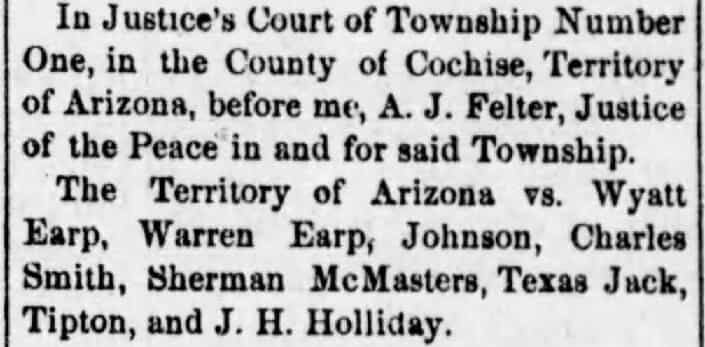
In Tucson they met for dinner in a restaurant. After Virgil and Allie boarded the train to Colton for Morgan’s funeral, Wyatt spotted Frank Stilwell, likely with Ike Clanton. Wyatt’s vendetta began right then. He chased them down and killed Frank, who was probably culpable in Morgan’s murder. The result was a warrant for Wyatt’s arrest, along with Warren, Doc, Johnson and Sherman McMasters.5
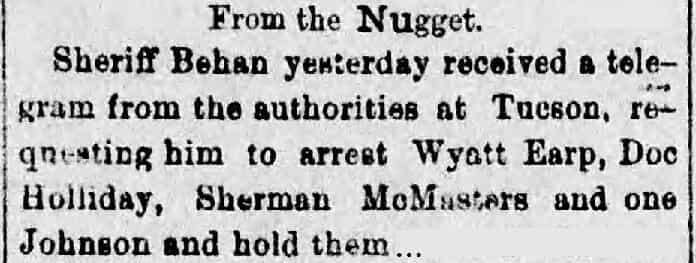
Back in Tombstone, County Sheriff John Behan unsuccessfully attempted to arrest Wyatt.5 Wyatt rode off with his posse, recruiting two others, Dan Tipton and Charlie Smith. Behan rounded up his own posse, including Cowboy associates, to hunt them down.6 He followed them through southern Arizona for days.
Wyatt’s vendetta posse hunted down Florentino Cruz (Indian Charlie).5 Wyatt’s account was that he killed him after he confessed to a part in killing Morgan. The coroner’s jury contradicted that, finding multiple gunshot wounds.6
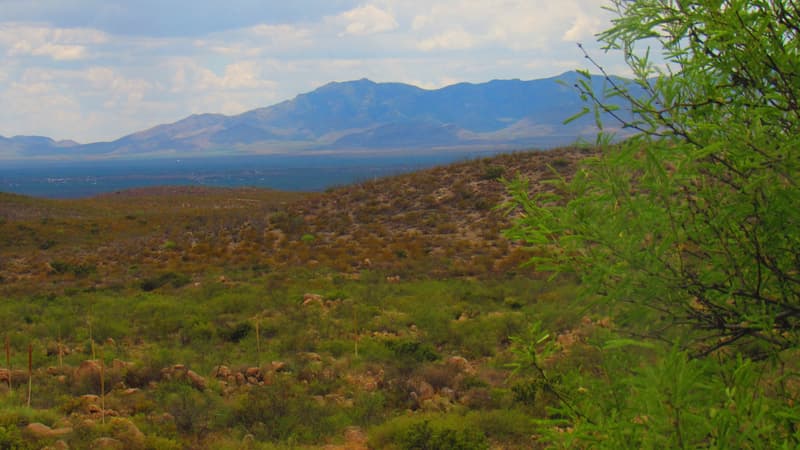
As they roamed the Territory looking for other culprits, Wyatt arranged a meeting to receive funds to finance his posse. With him now were Doc, Texas Jack Vermillion, Turkey Creek Jack Johnson and Sherman McMasters. That’s when they were ambushed by Cowboys at a spring in the Whetstone Mountains. In the gunfire, cowboy Johnny Barnes was hit and died later on. According to Wyatt, he spotted Curly Bill Brocius and shot him dead.6 That has never been verified.
So the posse was only partially successful, by Wyatt’s own measure.
The Legend Afterwards
With these killings:
- Justice was taken into their own hands, driven by Wyatt Earp’s desire for vengeance and backed by a federal badge.
- The local County Sheriff saw it as vigilante justice, resulting in warrants for Wyatt’s posse members.
The “Earp Party” left Arizona by April 21 to avoid the warrant. Sherman McMasters went along with them, heading into New Mexico.
After that, where did McMaster go? Investigators are still onto it.
There are stories around that are just that. Will McLaury, older brother of Tom and Frank, wrote that he was killed in a Cowboy shootout in 1884. Wyatt later claimed McMasters served in the Spanish-American War and died in the Philippines. There’s no evidence of that either.
There is also a family account. He had six siblings, and a probate record lists his death in Colorado in 1892.
Sherman McMasters was an intriguing character with two sides to him: good upbringing, lawman, law-breaker, and then, sort of, law-supporter.
McMaster or McMasters?
There are many reports of his life, many of them inaccurate and fanciful. Others do more careful research, with documentation.
Even his name has been transformed, with an “s” added to the end. Reading different accounts of Sherman McMasters, we see that sometimes there’s no “s” at the end of his last name. So which is it? Early census data show it as McMaster.3 However, the “s” has often been added, even back in the records of the 1880s. We’ve used an “s” here ourselves, to accommodate the many who search for information on him that way.
References
1 Brand, P. (2019). Wyatt Earp’s vendetta posse. As told in A Wyatt Earp anthology: Long may his story be told. Editors: R.B. Young, G.L. Roberts, C. Tefertiller. Denton TX: University of North Texas Press.
2 Breckenridge, W.M. (1928). Helldorado: Bringing law to the mesquite. Lincoln NB: University of Nebraska Press.
3 Brand, P. (2006). Sherman McMaster. Tombstone Vendetta. Retrieved from tombstonevendetta.com/shermanmcmaster.html
4 Stephens, J.R. (2013). Kindle Edition, Footnotes of Editor In Wyatt Earp speaks; Written by Earp, W., et al. Cambria, CA: Fern Canyon Press.
5 Lubet, S. (2004). Murder in Tombstone: The forgotten trial of Wyatt Earp. New Haven CT: Yale University Press.
6 Guinn, J. (2011) The last gunfight: The real story of the shootout at the O.K. Corral and how it changed the American west. New York: Simon & Schuster.
No comments yet