
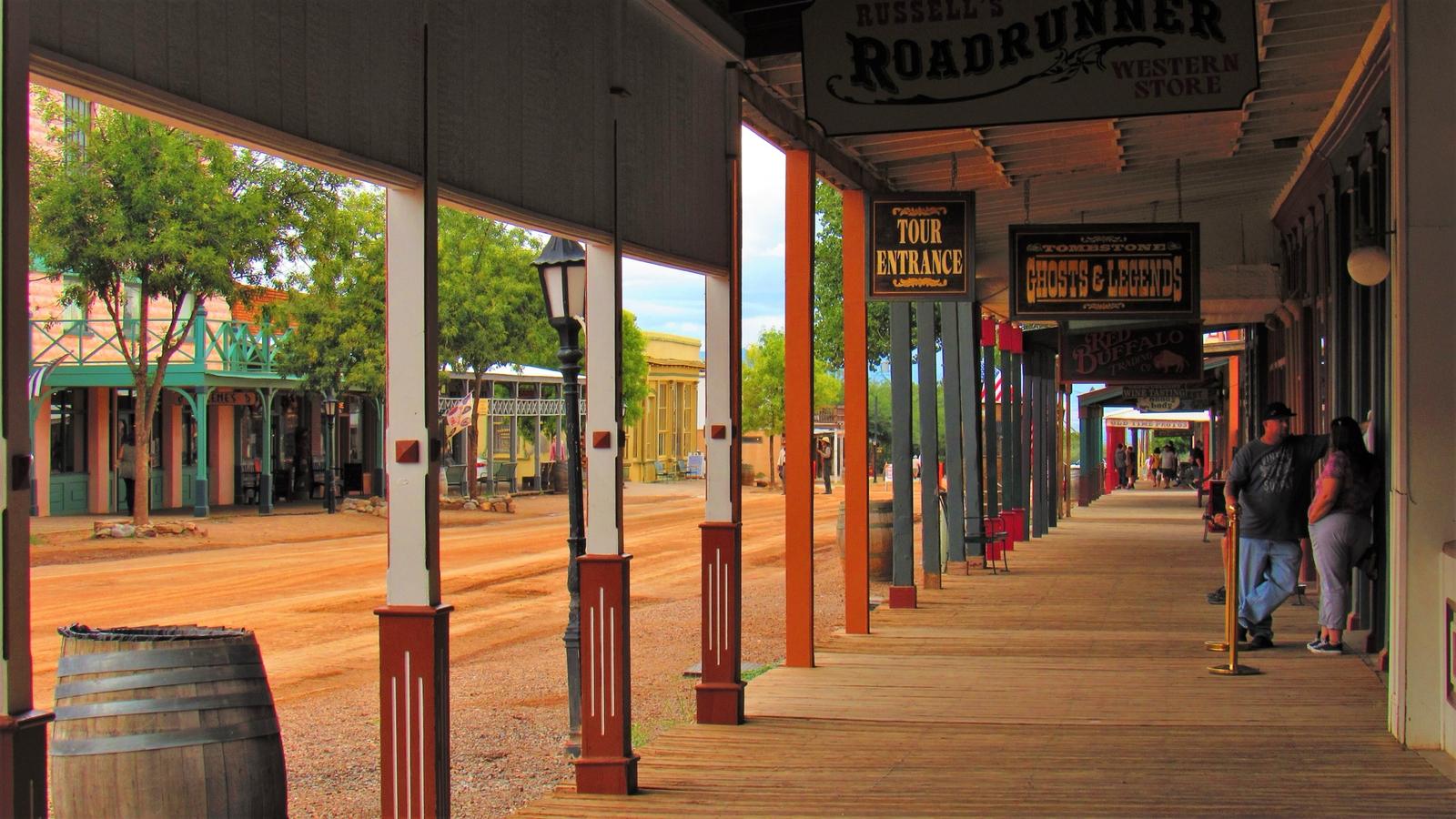
Does the name John B. Allen sound familiar? It should if you’ve walked through Tombstone. Allen Street, the town’s famous main drag, is named after him.
So who was he, and why did Tombstone name its business street for him? Here are the essentials of his story, from a Maine farm to Tucson’s pie trade, Tombstone’s first store and a lost grave.
From Maine to the Gold Rush
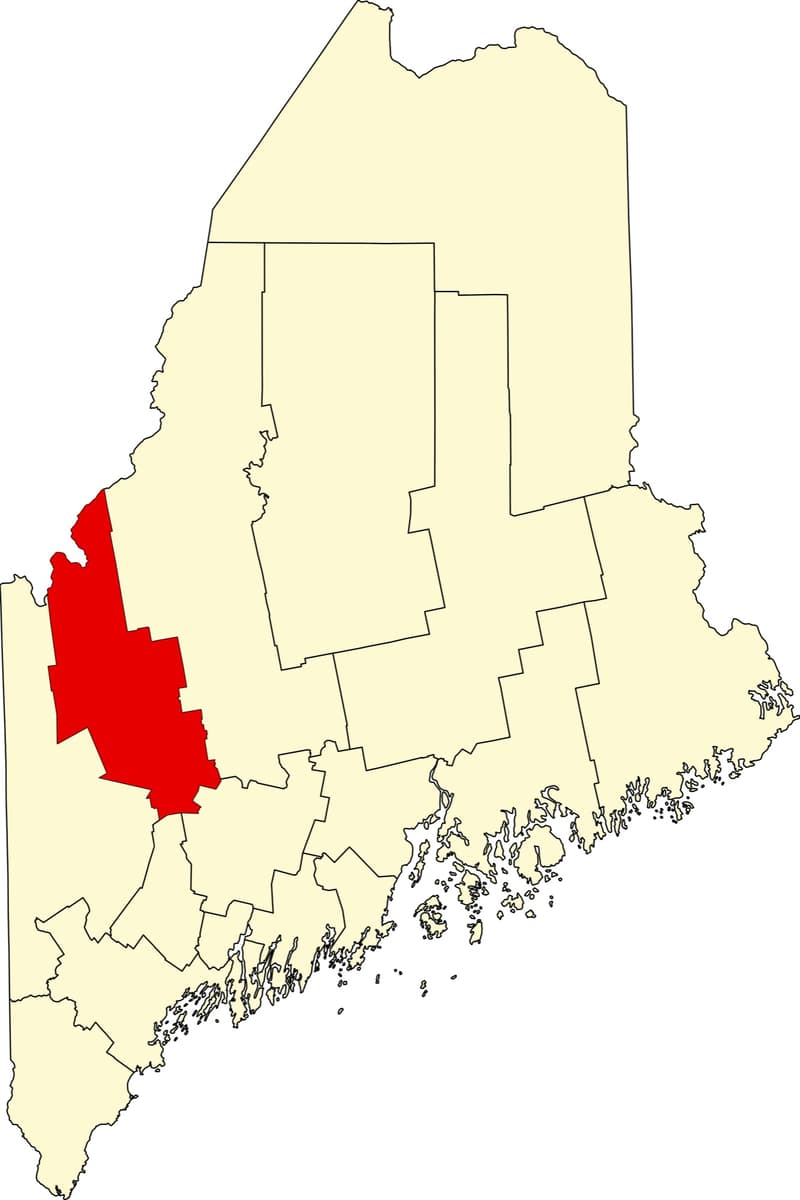
John Brackett Allen was born on October 22, 1818, in Franklin County, Maine. Not many details of his early life are known. He grew up in a farming family with five siblings and was educated in Boston.
The California Gold Rush drew him west. He was 39 when he reached Arizona Territory, first at Yuma and then at the Gila City gold rush. About a year later he was in Tucson.
“Pie” Allen of Tucson
By then he was tired of chasing gold. Instead of pie-in-the-sky dreams, he started baking pies. Word spread around Tucson, his dried-apple pies became the local rage, and people started calling him “Pie Allen.”
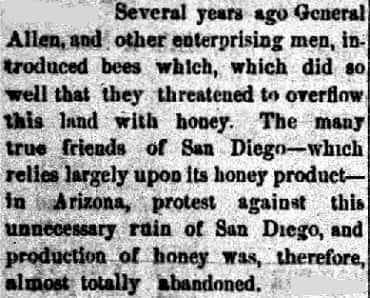
With the profits he opened his first general store, then more stores, and branched into farming, ranching, building and beekeeping. He is credited with filing the first homestead claim in Arizona Territory.
Political Career
With all his business contacts, politics came naturally to John Allen. During the reign of Emperor Maximilian he supplied arms to the anti-royalist forces in Mexico. In the territorial legislature he led the push to move the territorial capital from Prescott to Tucson, which was not popular in Prescott. The capital moved to Tucson in 1867.
On November 18, 1867, Allen became one of the superintendents of Arizona’s first school district. The next month he was appointed territorial treasurer, and under his management the territory’s deficit was soon erased.
Later he was appointed the territory’s adjutant general, which earned him the nickname “General Pie.” He became mayor of Tucson on April 15, 1876, and won election to a full term the next year.
We haven’t asked permission to reproduce the one known photo of him, but you can see the portrait of Pie Allen at the Arizona Memory Project.
Allen in Tombstone
Pie Allen was best known in Tucson, but he lived in at least eight other southern Arizona towns, Tombstone among them. When he heard of the silver discovery at Tombstone, he headed that way. His first stop was Millville, the first town at the ore-milling site on the San Pedro River, where he became the first postmaster on May 26, 1879. Charleston, across the river, soon overtook it, and Millville became a ghost town.
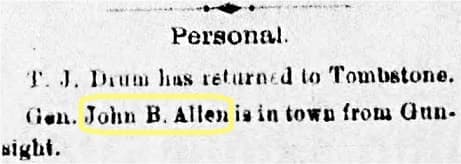
In 1879 he moved to Watervale, the Tombstone Mining District’s first settlement, and set up a store there. He sold it when the Tombstone townsite was being laid out and moved to Gird Camp, also called Upper Town (many locals still say “uptown”). There he opened the first business in town: a store and boardinghouse in a wood-framed tent.
Upper Town, Tombstone, Arizona Territory
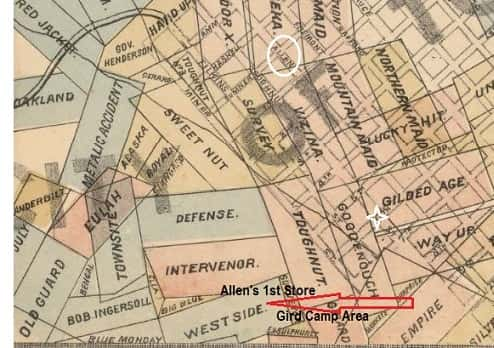
To find the spot today, stand at the corner of Toughnut and Sixth streets, across from the large parking area. Look south up the hill and imagine Gird Camp in 1879.
A deal was struck for a townsite survey covering Upper Town and nearby Goose Flats, and the claim was filed and recorded in April 1879. The business street was named Allen Street because John B. Allen was the first tradesman in town. The main thoroughfare through town was Fremont Street, since it wasn’t blocked by a gulch.
Pie Allen also got into local politics, promoting the town’s incorporation. Pima County granted the petition on November 1, 1879, with an election planned soon after. Allen gave up his original Gird Camp operation.
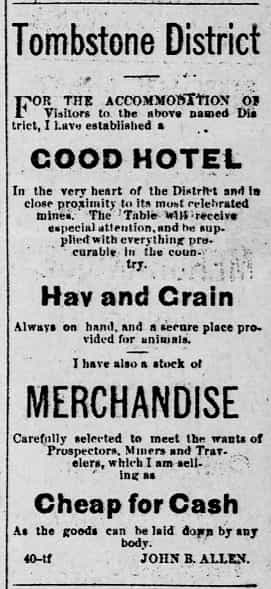
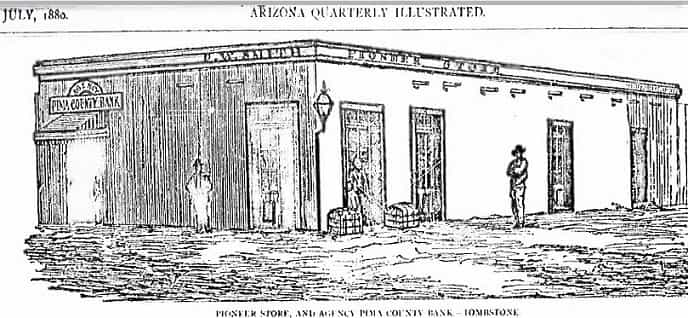
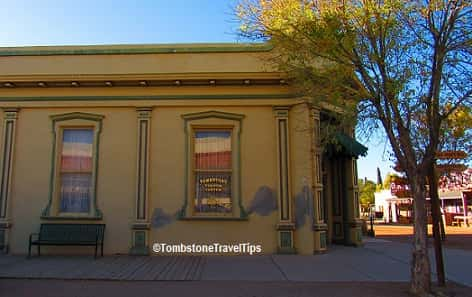
He started a store, stable and blacksmith shop at the southwest corner of Fourth and Allen streets. It struggled, and he sold out to Philip W. Smith. It became the Pioneer Store, which housed Tombstone’s first bank.
In 1881, at 63, Allen married a teenager, Lola Tapia. Her mother agreed only on condition that Lola live in a convent. She stayed there until the next year, when she gave birth to a daughter, Molly Mae Allen. The marriage lasted until 1891, when Allen was granted a divorce on grounds of his wife’s infidelity.
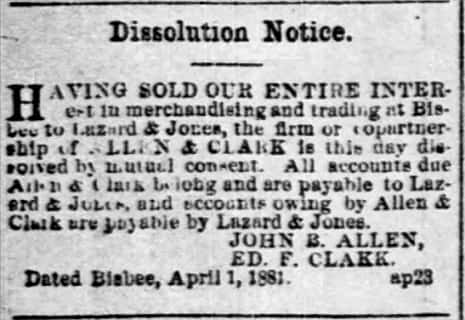
Meanwhile, Allen had also been in Bisbee, but he sold his partnership there by spring 1881. He tried many ventures to build up his finances, going back into mining and buying and selling land. In the end he didn’t have much.
An Unusual Burial for a Pioneer
In 1899, at 80, Allen was dying of cancer. To honor him, his Tucson friends held a testimonial dinner in April 1899, and Zeckendorf & Co. presented him with a tombstone. William Zeckendorf was “a flamboyant merchant,” according to the Jewish Museum of the American West, and likely knew Allen through both business and the legislature.
Etched in the stone: John B. Allen, born 1818, died 1899. Territorial Treasurer six years. Mayor of Tucson two terms. A man without an enemy.
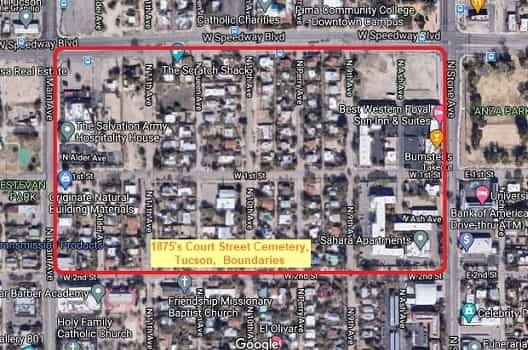
Allen was pleased and accepted it graciously. He died on June 13, 1899, and was buried in the paupers’ section of Tucson’s Court Street Cemetery, opened in 1875, among likely nearly 5,000 others.
As Tucson grew, it spread over the cemetery land. The graves were to be relocated, but apparently only some headstones were moved. Historians believe many remains were left behind, for reasons that are unclear, and the records have not been found.
John B. Allen’s headstone was moved, without his remains, to Pima County Cemetery in Tucson. His wealth had dwindled by the time of his death. Sadly, his marker no longer shows the distinguished positions he held in Arizona Territory or in Tucson: the stone is said to be partly buried, with only his name and dates visible. One day we’ll go and see for ourselves.
The Pie Allen Historic District
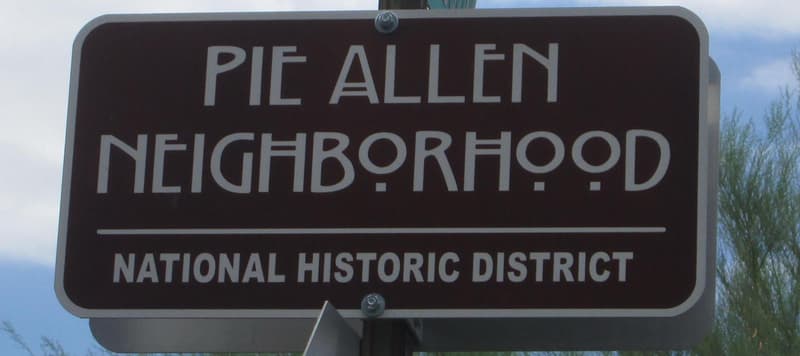
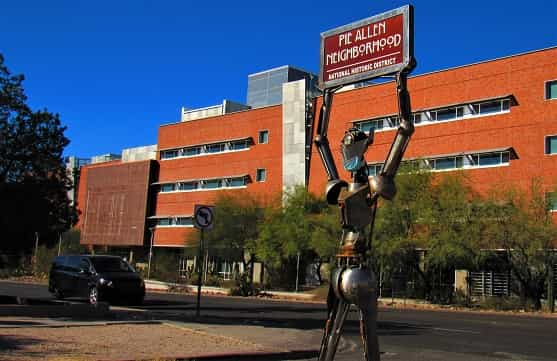
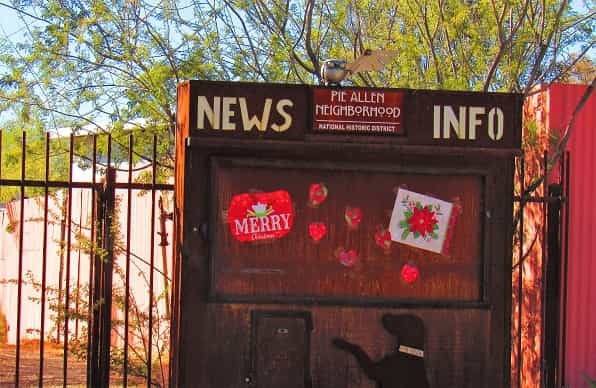
Tucson did eventually honor his memory. The Pie Allen neighborhood is named for John Brackett Allen, and in 1996 it was listed on the National Register as the Pie Allen Historic District. Even so, we wonder how many people there know who he was.
Places and events like these make us curious about the people who roamed the Tombstone area and the Old West. What’s the true story? We enjoy digging into the history and sharing what we find. When you’re in town, walk down Allen Street and think of the pie maker who opened its first store.
No comments yet