- Family and early years in Georgia
- Doc Holliday the dentist
- Doc Holliday goes west
- Doc’s Wild West years
- Doc Holliday goes to Arizona
- Doc Holliday in Tombstone
- Doc Holliday in the O.K. Corral gunfight
- Wyatt Earp’s vendetta posse
- Doc Holliday in Leadville, Colorado
- Doc Holliday’s last days and death
- The Doc Holliday legend lives on
Doc Holliday was born John Henry Holliday in Griffin, Georgia, a little south of Atlanta, on August 14, 1851. He is remembered for the Gunfight at the O.K. Corral, but his short life took him from a Georgia dental chair to the gambling halls of Texas, Kansas, Arizona and Colorado.
Here is his story from childhood to his last words in Glenwood Springs, with the newspaper reports of the day along the way.
Family and early years in Georgia
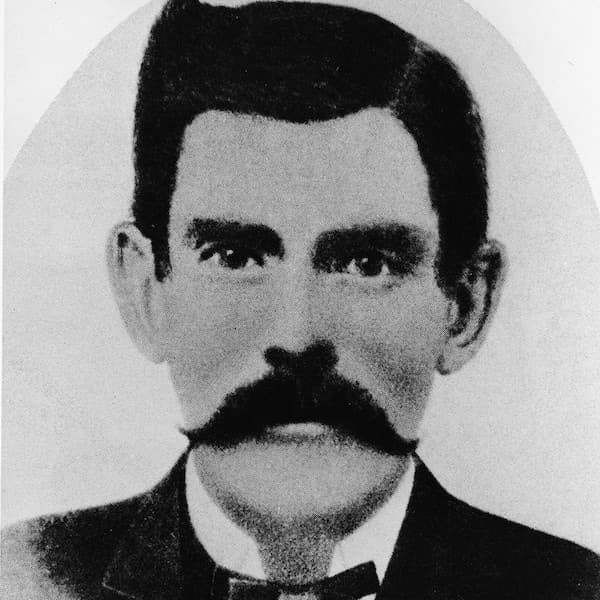
Doc’s ancestral roots were Scottish and English. His mother was born Alice Jane McKey. His father, Henry Burroughs Holliday, served in the Mexican-American War and later as a major in the Confederate army during the Civil War. Both were natives of South Carolina, and they married on January 8, 1849.
The Mexican-American War ended in 1848. When Henry returned to Griffin, he brought a war-orphan boy home with him. Named Francisco Hidalgo, the boy was adopted as a son.
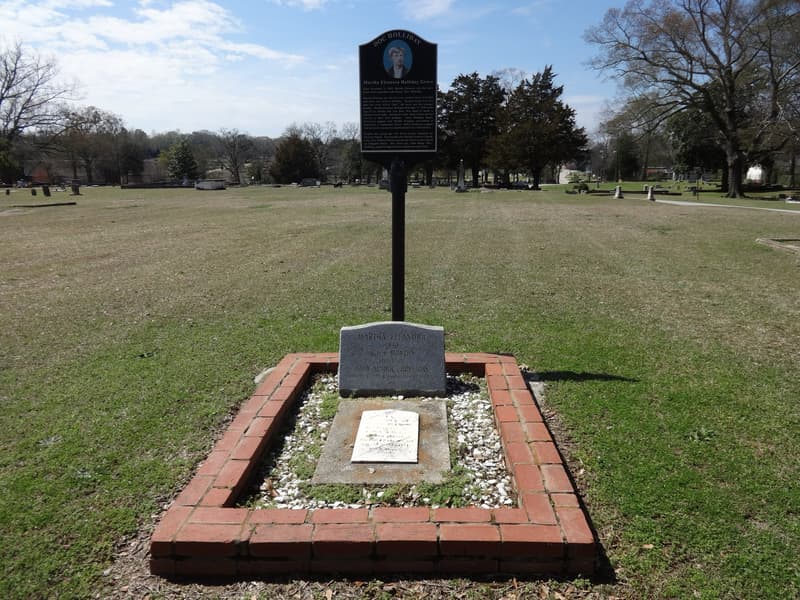
Henry and Alice had their first child, a daughter named Martha Eleanora, on December 3, 1849. She died when she was just over six months old.1
John Henry was baptized at the local First Presbyterian Church on March 21, 1852. He was born with a cleft palate, and his parents obtained corrective surgery for him.4
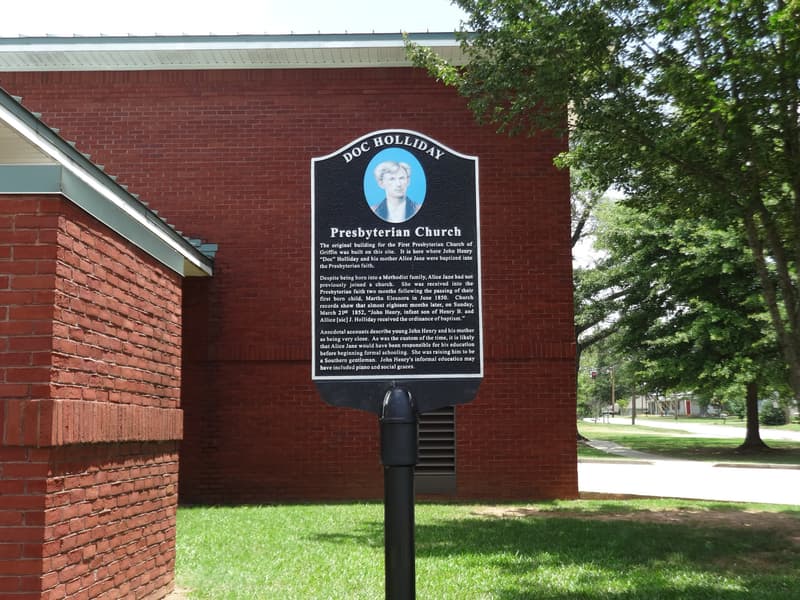
John grew up in Griffin with his adopted brother, Francisco, and three of his mother’s siblings.3 When he was old enough, his father taught him to shoot and handle a gun. His mother taught him piano and worked with him on speech and manners.4
In 1864 the family moved to Valdosta, Georgia, where John spent his school years at a private school, the Valdosta Institute. The school is gone, but a historical marker records its place.2 It gave him a classical education that stayed with him through life.
Yes, Doc Holliday knew Latin
He studied French and Latin, and a bit of Greek. One course he enjoyed was rhetoric, the art of advanced English usage, and it shaped the way he spoke for the rest of his life. There is a famous scene in the Tombstone movie where Doc speaks Latin with his nemesis, Johnny Ringo. The scene is invented, but it is plausible, since Doc was known for florid language and for speaking Latin. If you have ever wondered what they are saying, see our Tombstone Latin translation.
A death in the family and cousin Mattie
On September 16, 1866 his mother, Alice, died of tuberculosis, then known as consumption. We don’t know what young John thought when his father remarried three months later. His new wife, Rachel Martin, was a young woman from down the street, much younger than Henry Holliday.3
Less than a year later, John was sent to north Georgia to spend a summer with relatives. Post-Civil War Reconstruction was under way in the South at the time, which may have played a part in the visit.
Robert Kennedy Holliday, John’s uncle, lived in Jonesboro, Georgia. His daughter Mattie, Doc’s cousin, was about a year and a half older than Doc. The two hit it off and kept a lasting, close friendship.3
Doc Holliday the dentist
In 1870 John Holliday went to Philadelphia and enrolled in the Pennsylvania College of Dental Surgery. The course took two years, plus dental labs and clinical work. His father paid his tuition and books, and John helped by working summer jobs in Valdosta.
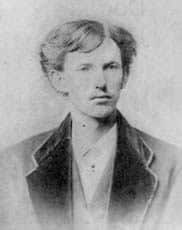
He received his Doctor of Dental Surgery degree on March 1, 1872, at age 20. He was too young to practice in Georgia until he turned 21.
His solution was to work with a fellow graduate, A. Jameson Fuches, in Fuches’s hometown of St. Louis, Missouri, until John’s birthday.3
At 21, John Henry returned to Georgia. He received his inheritance through his mother’s side and took a position as a dentist in Atlanta, working alongside Dr. Arthur C. Ford. There he roomed with his uncle, Dr. John Stiles Holliday.3
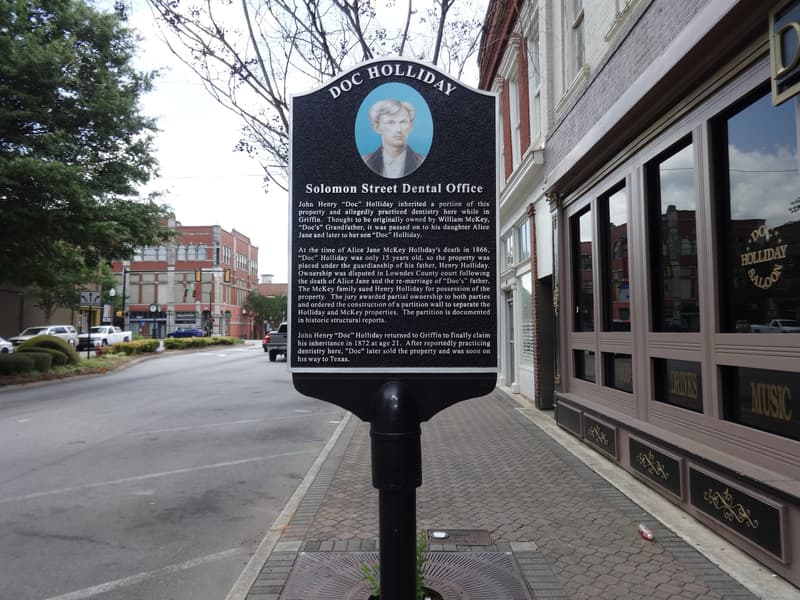
His adopted brother Francisco had married and had six children. They lived east of Griffin, in Jenkinsburg. Francisco had contracted tuberculosis, and he died January 13, 1873. Doc probably attended his funeral, as the next day he returned to Griffin to complete a property sale.3
Why Doc left Georgia
Nine months later, Doc was in Dallas, Texas. Several stories circulate about what happened before he left:3
- He left the Atlanta practice and opened his own office in Griffin with his inheritance.
- His relationship with cousin Mattie was troubled. She had feelings for him, but as a Catholic she did not want to become more involved, since they were too closely related. He tried to overcome her objections.
- His tuberculosis symptoms began. He had been exposed to his mother and his brother over the years, and he likely caught the disease from one of them.
- He had a run-in that made him want to avoid the law. Local boys used a swimming hole on Holliday land along the Withlacoochee River. One day Doc chased a group of Black youths away from the river, firing a gun. One version, told years later by Bat Masterson, says he killed two of them. Family members said he shot over their heads, and historians have found no contemporary evidence of the incident. No charges were filed.
Doc Holliday goes west

In Dallas, Doc began a dental practice. He moved there for the drier climate, which his doctors advised might ease his tuberculosis.
He partnered with Dr. John A. Seegar, a friend of his father’s, in an office on Elm Street.5 Together they won awards for their dental work at the Dallas County Fair.6
On March 2, 1874 a Dallas newspaper reported that the two dentists had gone their separate ways. Doc opened his own practice in an office over a bank in town. It didn’t go well. His constant coughing spells cost him patients, and he lost interest in a practice he could not keep up.
Gambler and gunfighter
The Old West saloons of Dallas drew more and more of his attention. He enjoyed cards and was good at gambling, and alcohol eased the pain of his illness. Soon he was relying on gambling for his income.
He began to promote and embellish tales of his own gunplay. A dangerous reputation helped a man who looked rather sickly.
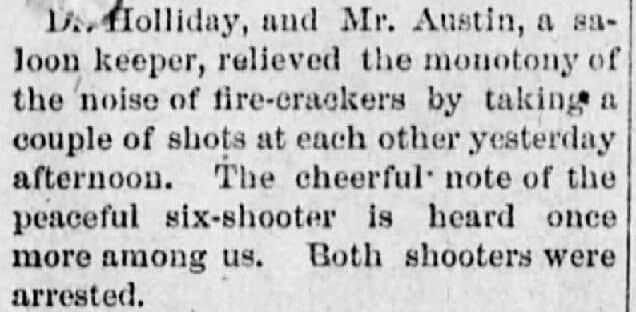
In January 1875 Doc was arrested after trading shots with a saloon keeper in Dallas; no one was hurt. Not long after, he left town. Some say he had shot and killed an important local man. His next stop was west Texas.5
Doc’s Wild West years
In Fort Griffin, Texas, Doc kept gambling. In June 1875 a grand jury there indicted him for illegal gaming in a saloon. He paid a fine and moved on.7
Next he headed for Denver, Colorado. Along the way he reportedly stopped in Jacksboro, Texas, where rumor says his reputation earned him the name “the Deadly Dentist.”5 In Denver more tall tales of his menacing ways grew. Over the next couple of years he also spent time in Cheyenne, Wyoming, Dodge City, Deadwood and Breckenridge, Colorado.7
He returned to Fort Griffin in late 1877. It was a momentous trip.
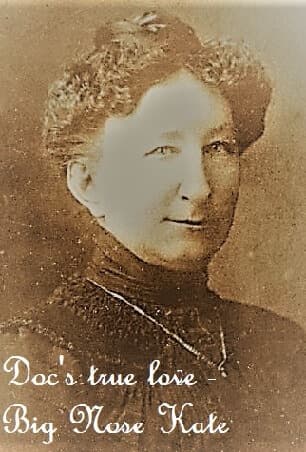
There he met two people who played a large part in his life. In John Shanssey’s saloon he met Mary Katherine Harony, better known as Big Nose Kate. He also met Wyatt Earp there, the beginning of a lifelong friendship. Did Wyatt Earp really write about that friendship in a book called “My Friend Doc Holliday by Wyatt Earp“? Our article looks into it.
After leaving Texas, Doc and Kate headed for Dodge City, Kansas.
Dentistry in Dodge City
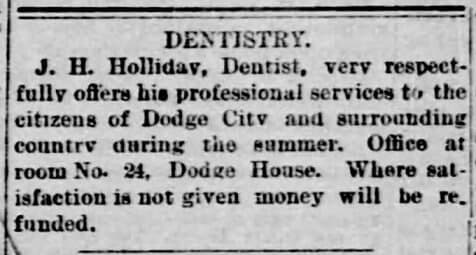
Big Nose Kate arrived in Dodge with Doc at the beginning of June 1878. Doc tried to make an honest living at dentistry again. He rented an office at the Dodge House and often worked all day, but his evenings went to gambling.
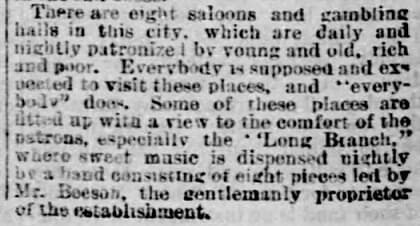
Wyatt Earp was in town as assistant city marshal, and he and Doc renewed their friendship. Wyatt found Doc useful in some of his work.
Wyatt later said that during that summer a cowboy crept up behind him to shoot him in the back, and that Doc saw it, warned him and shot the man. Wyatt credited Doc with saving his life and told the story for the rest of his days, although no Dodge City newspaper of the time reported the incident.7
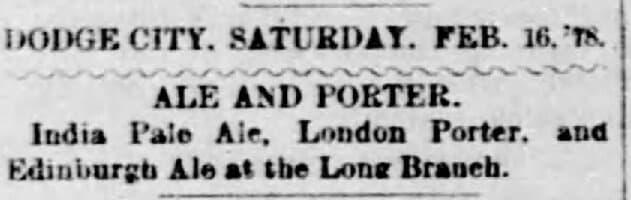
In Dodge City Doc also met other men who became well known: Bat and Ed Masterson, Luke Short, Charlie Bassett, Mayor James “Dog” Kelley, Long Branch Saloon co-owner Chalk Beeson and the entertainer Eddie Foy.7
In late 1878 Doc left Dodge for a drier climate again. His health had taken a downturn with pneumonia. He went to Trinidad, Colorado, to recover, then south to Las Vegas, New Mexico.7
Doc Holliday goes to Arizona
In Las Vegas, Doc kept at his sideline, the gaming tables. In 1879 he opened a saloon there with John Joshua Webb, a former Dodge City lawman. In October 1879 Wyatt Earp arrived and told him about the silver strike at Tombstone, Arizona.
Stories of Doc in gunfights and killings surfaced during those years, especially in New Mexico. Little of them can be confirmed.8 Much of it was probably bluster to keep up the Doc Holliday reputation.
What guns did Doc Holliday carry?
Because of his gambling, Doc wanted protection with him. His father had trained him well in handling guns, but his disease sapped his strength, so he chose weapons with his health in mind.
What he liked best were two double-action Colt revolvers. Doc carried either the nickel-plated .41 caliber Thunderer or the .38 caliber Lightning.
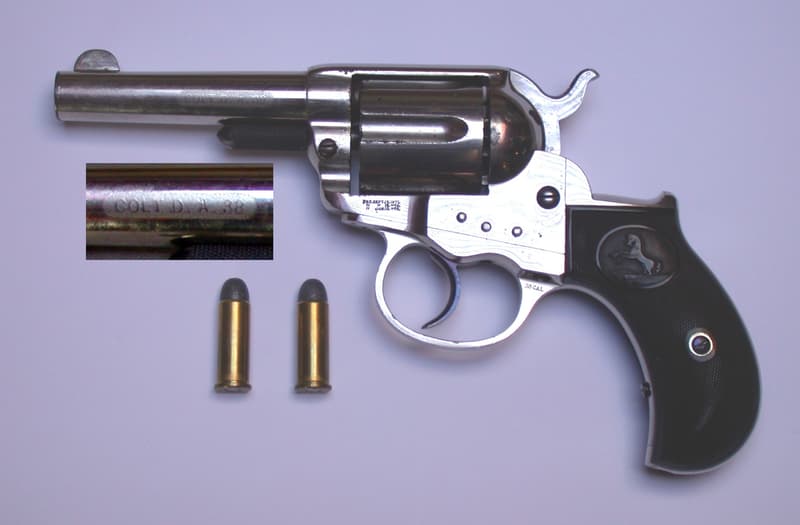
Our article on Doc Holliday’s guns goes into more detail.
Doc Holliday in Prescott, Arizona
Wyatt was on his way to Prescott, where his brother Virgil Earp lived. Virgil was about to take a lawman’s job in Tombstone, and the Earp brothers were interested in silver mining there. Doc and Kate left Las Vegas with the Earps the day after Wyatt arrived.
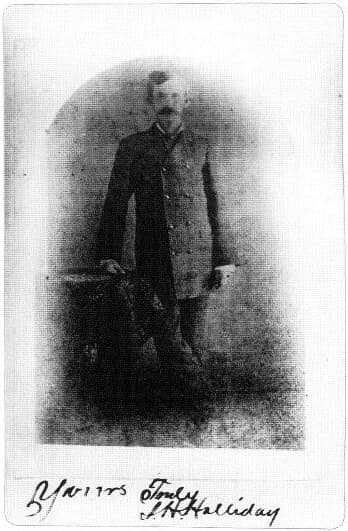
Doc started gambling in Prescott and stayed on, since his winnings were good and regular. He met John Behan while gaming there, and he would meet him again in Tombstone.
Kate and Doc lived together in a Prescott hotel room. Arguments arose between them. She wasn’t fond of Wyatt Earp, who was trying to convince Doc to come to Tombstone. Both were intelligent, strong personalities, which led to clashes, but their attraction kept them together. Doc finally decided to join Wyatt in Tombstone.
Kate refused to go with him. She moved to Globe, Arizona, instead.
Doc Holliday in Tombstone
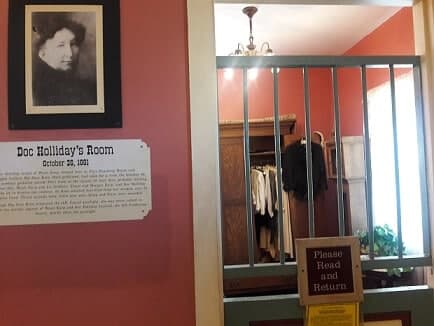
Doc Holliday arrived in Tombstone in September 1880. He later roomed at Fly’s Boarding House. Big Nose Kate joined him from time to time, probably three times while he lived in Tombstone. Each time they eventually got into a bad argument, and he threw her out or she left.7
In Tombstone, Doc gambled steadily, dealing games and playing them. All along he drank to ease the pain and coughing spasms of tuberculosis; his favorite is said to have been Old Overholt whiskey. Steady drinking builds a tolerance, so over time he could drink a good deal without showing obvious effects.
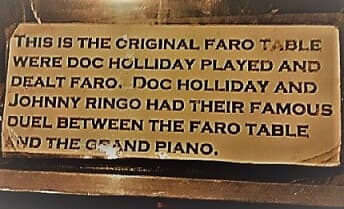
His reputation spread around town. Locals in the saloons and gambling dens knew him, as did the ranch hands and cowboys who came into town, and the local lawmen learned his name. He often gambled at the Oriental Saloon, at the northeast corner of Allen and 5th Streets. The owner, Milt Joyce, wasn’t fond of him.
Doc’s Tombstone troubles begin
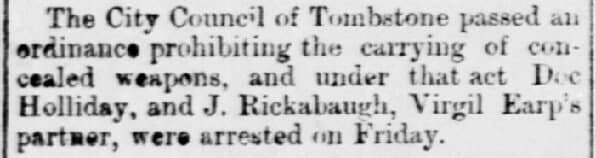
In October 1880, only weeks after he arrived, Doc got into an argument at the Oriental and Joyce threw him out. Doc got his gun and came back. He fired at Joyce, who pulled out his own pistol, and Doc’s bullet went through Joyce’s hand. William Parker, who was behind the bar, was hit in the toe. Joyce then clubbed Doc over the head with his pistol, knocking him out, and lawmen ended the fight.5
On March 15, 1881, a stagecoach was attacked north of Tombstone. The robbers killed the driver, Eli “Bud” Philpot, and a passenger, Peter Roerig. Shotgun messenger Bob Paul fired back and wounded one of the bandits, Bill Leonard, who was a friend of Doc Holliday’s. Rumors soon had Doc taking part.
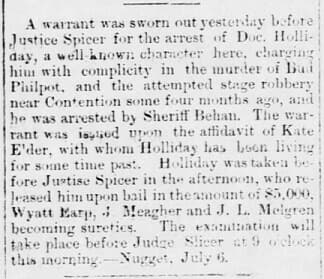
Sheriff John Behan and Milt Joyce later came across Big Nose Kate drinking in a saloon, grumbling about a recent argument with Doc in which he’d told her to get out.
Behan and Joyce talked to her and bought her more drinks. In her drunken, angry state, she signed an affidavit stating that Doc had taken part in the stage robbery, and a warrant for his arrest was issued.
When Kate sobered up, she said Behan and Joyce had talked her into signing a document she did not understand. With that and witnesses to Doc’s whereabouts on the night of the robbery, the charges were dismissed. Doc was angry at Kate for what she had done. He gave her money and put her on a stagecoach out of town.
Tensions flare
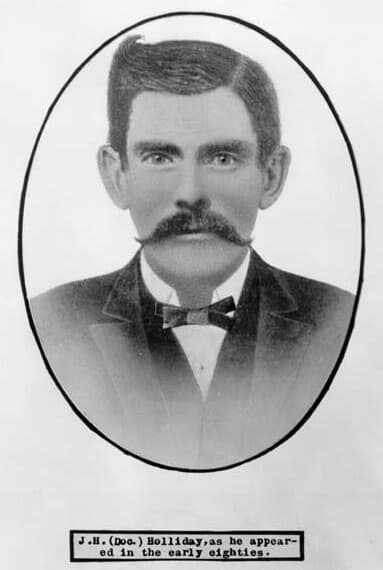
Wyatt Earp still called on his good friend whenever he needed extra men for law enforcement and posse work.
On August 13, 1881, “Old Man” Clanton, father of Ike and Billy Clanton, was killed with four other men in an ambush in Guadalupe Canyon near the Mexican border. Historians generally believe Mexican troops did it, but rumors spread that the Earps were responsible, and some writers have suggested that Doc and Warren Earp were involved.5 Doc was walking with a cane by October.
Locals saw Doc clash with Ike Clanton on the evening of October 25, 1881. Both had been drinking all day, and at the Alhambra Saloon they started insulting each other.7 Doc challenged Ike to try shooting him. Ike said he wasn’t armed, as city law required, and Doc told him to go get a gun.5
According to one account, Doc ended it by claiming he had killed Ike’s father and threatening the same for Ike.5 Both left for the night: Ike to the Grand Hotel, Doc home to Fly’s and Big Nose Kate.
The next morning, October 26, 1881, Ike knocked on their door looking for Doc. Mrs. Fly sent him away, since Doc and Kate were out, and later told Kate that Ike had come by. When Doc found out, he said, “If God will let me live long enough, he will see me.”5
Doc heard that Ike was roaming town that morning threatening the Earps. At one stop, Kelly’s Wine House, Ike boasted that “The Earps and Doc Holliday are about to be shot.” Doc is said to have told Billy Clanton on the street, “Glad to meet you. Hope to kill you soon.”7
Doc Holliday in the O.K. Corral gunfight
Doc met Virgil, Wyatt and Morgan Earp at Hafford’s Saloon to discuss Ike.7 There was more to it by then. The Clanton brothers were with the McLaury brothers. They had been to Spangenberg’s gun shop and then gone to a lot off Fremont Street, near the O.K. Corral.
Virgil said they must disarm the Cowboys. According to Wyatt, he told Doc this wasn’t his fight. Doc was insulted and somewhat hurt that his good friend would say such a thing, and replied, “That’s a hell of a thing to say to me.” Virgil Earp deputized Doc for the job.7
The four of them walked down 4th Street and turned west on Fremont Street. John Behan tried to head them off, saying he had already disarmed the Cowboys. Doc and the Earps brushed him aside.
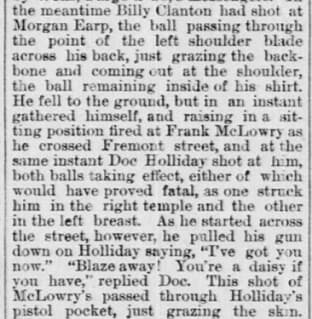
In the lot near the O.K. Corral they found Ike and Billy Clanton, Frank and Tom McLaury, and Billy Claiborne. Virgil demanded their guns; his exact words are not known. Seconds later the shooting started, and it is still unclear who fired first. About 30 shots rang out in 30 seconds.
As the shooting started, Ike and Claiborne ran off. Both McLaury brothers were mortally wounded and died within minutes, and Billy Clanton was killed. Doc did a lot of the damage. He killed Tom McLaury with a shotgun blast, hit Frank McLaury and probably hit Billy Clanton. Doc himself was only grazed.
For the full story, read our account of the shootout at the O.K. Corral.
The aftermath
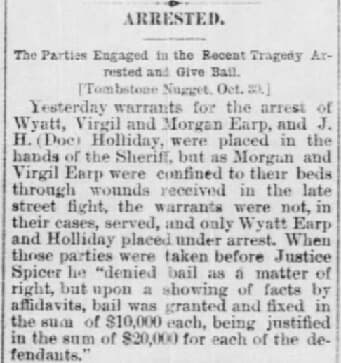
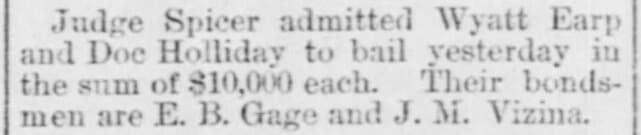
Ike Clanton soon filed a murder complaint, and a warrant was issued for the arrest of Wyatt Earp and Doc Holliday. Virgil and Morgan Earp had been seriously wounded and were not charged at first.
Witnesses testified through November 1881. Justice of the Peace Wells Spicer ruled that “the defendants were fully justified in committing these homicides” as part of their duty as officers.5
Virgil ambushed
Ike and his fellow Cowboys didn’t take the ruling well. On the night of December 28, 1881, Virgil Earp was ambushed on Allen Street, near the Crystal Palace Saloon, after leaving the Oriental. Shotgun pellets struck his left arm, side and back. He survived, but his arm was crippled for life. Witnesses named several Cowboys as suspects, but no one was convicted.
Ringo confronts Doc
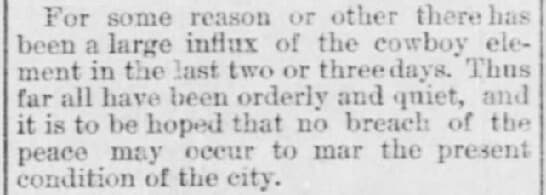
In mid-January 1882, Johnny Ringo, a friend of the Cowboys, accosted Doc on the street. Ringo was quite drunk, and Doc wasn’t entirely sober. Ringo challenged Doc to a shootout. Wyatt was nearby and stepped in, along with lawman James Flynn, and the two were separated. That ended it for the time being.5
Morgan Earp murdered
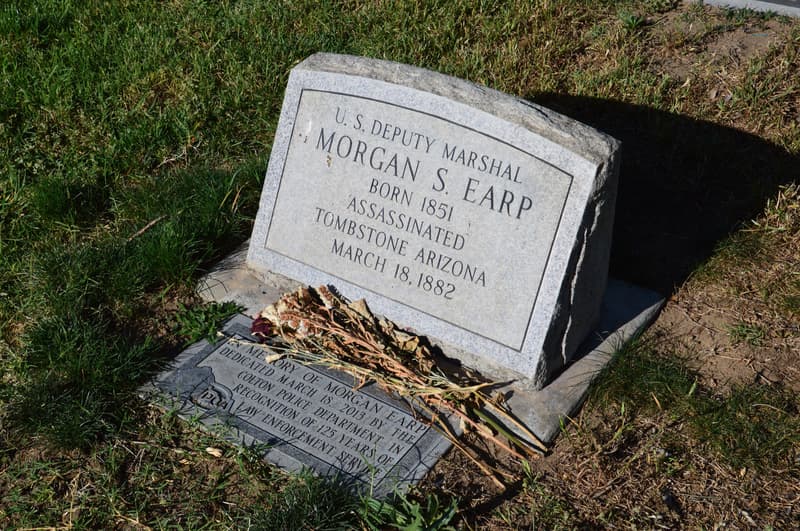
On March 18, 1882, Morgan Earp was shot and killed while playing pool at Campbell & Hatch’s on Allen Street. It shook Wyatt to his soul. Doc reacted with his heart and gut, searching Tombstone and breaking down doors where he thought the killers might be.
A coroner’s jury named the men it believed responsible, Frank Stilwell among them.5 Wyatt resolved to get justice for Morgan in his own way, and Doc stood by him. Doc and Wyatt rode the train to Tucson escorting Virgil and Allie Earp, who were taking Morgan’s body to the Earp family home in Colton, California, for burial.
In Tucson on March 20, 1882, Frank Stilwell was seen near the train. A chase followed, and Wyatt shot and killed him. Doc reportedly fired at Stilwell’s body as well. Warrants named Doc, Wyatt and others in their party for Stilwell’s death.5
Wyatt Earp’s vendetta posse
Wyatt set out to get everyone behind his brother’s murder, and his friends, including Doc, rode with him. Cochise County Sheriff John Behan had warrants for them and tried to arrest Wyatt and Doc as they left town, but they refused to be detained.
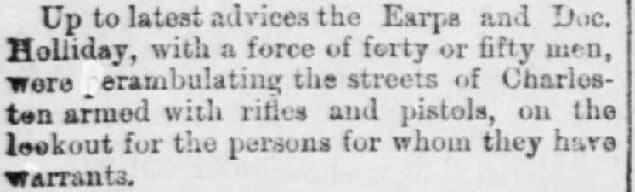
On March 22, 1882 they rode into the Dragoon Mountains looking for Pete Spence. At Spence’s wood camp they found Florentino Cruz, and when he ran from the posse, they shot him down.
Next they went to Iron Springs in the Whetstone Mountains, where a group of Cowboys was waiting. In the fight, Wyatt is said to have killed Curly Bill Brocius and wounded Johnny Barnes. The others escaped. Curly Bill’s body was never recovered.
Since John Behan had not arrested Wyatt and Doc, he raised a posse to do it. After Iron Springs, Wyatt’s party rode to Henry Hooker’s Sierra Bonita Ranch, southwest of Safford, Arizona. Hooker gave them food and shelter and stood up for them when Behan’s posse followed.
Wyatt and Doc leave Arizona
In April 1882 Doc and the rest of Wyatt’s posse left Arizona Territory, knowing it was in their best interest. They entered New Mexico Territory and spent their first night in Silver City.
From there they went to Deming and on to Albuquerque. Witnesses reported an argument between Wyatt and Doc at a restaurant there over Wyatt’s relationship with Josephine Marcus; Doc made a slur about her Jewish heritage.5,7
They went their separate ways, Wyatt to Gunnison, Colorado, and Doc to Denver.7 In May 1882 Doc was arrested in Denver on an Arizona warrant.
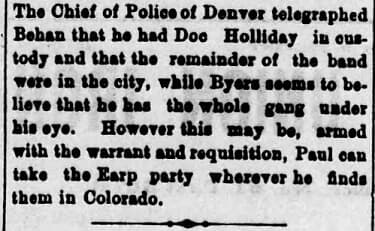
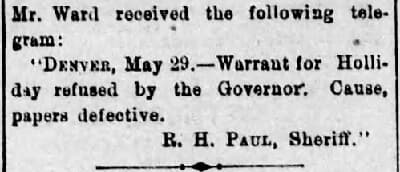
Colorado Governor Frederick Pitkin refused to send Doc back to Arizona, so he stayed in Colorado.
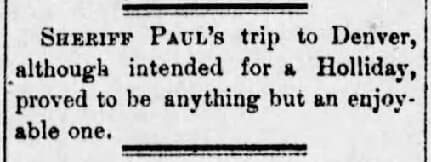
The next month Doc went to Gunnison and met up with Wyatt. Doc’s health was failing. He was very thin and weak, his cough was bad, and he looked much older than his 31 years. Still he carried on through a few southern Colorado towns and ended up in Leadville at the end of 1882.
Doc Holliday in Leadville, Colorado
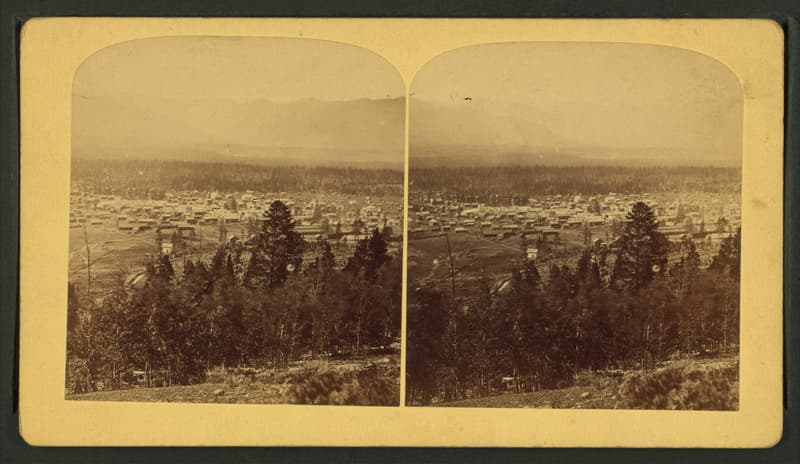
Leadville’s high elevation was hard on his lungs. By then tuberculosis had likely destroyed much of his lung tissue, and the thin mountain air meant even the healthy part took in less oxygen. That would have dulled his gambling skills, and it did.
He also self-medicated with whiskey and regular doses of laudanum. His thinking was fuzzy and his winnings dropped. His losses grew so bad that he pawned his jewelry and borrowed small sums from friends and enemies alike, and he was slow to pay them back. That led to another notorious incident.9
His hangout in Leadville was Hyman’s Saloon. In August 1884 a bartender named Billy Allen demanded that Doc repay a $5 loan, or else. Doc heard that Allen was coming for him.
When Allen came through the saloon door, Doc fired. His first shot missed. His second hit Allen in the arm, and patrons disarmed Doc.
Doc was arrested. On March 28, 1885 a jury found him not guilty on grounds of self-defense. Part of his defense was his weak condition.5,9
Doc Holliday’s last days and death
In May 1887 Doc made his way to Glenwood Springs, Colorado. The springs there were said to have healing properties, though their sulfurous fumes were no help to a tubercular lung.
He took a room at the Hotel Glenwood, which catered to people visiting the local hot springs, in particular the Yampah Hot Springs. A man he had known in Tombstone, Charlie Smith, was in town at the time, and it is from Smith that we have a look at Doc’s last days.
Origen Charles Smith’s notes survived for more than a century, preserved by descendants of one of Smith’s associates. One of them, Clifton Brewer, worked with Karen Holliday Tanner, a relative of Doc’s, to publish them. Tanner also wrote a well-regarded biography of John Henry Holliday.10
Here is what Smith’s memoranda tell us.10
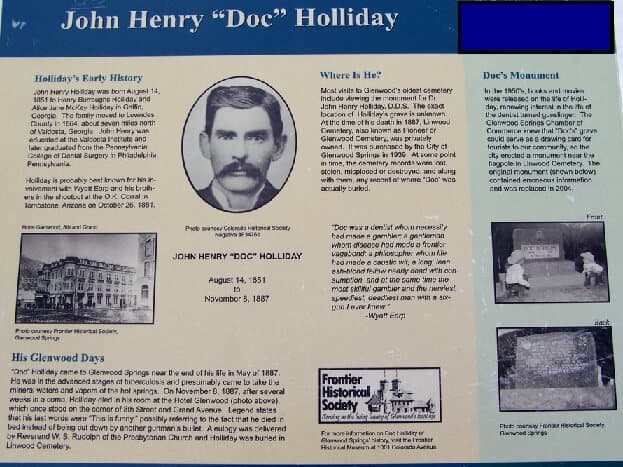
Smith had a room across the hall from Doc at the Hotel Glenwood. He kept journals and wrote letters describing what happened. He said Doc came from Leadville on the narrow-gauge railway, a hard trip for him. He coughed constantly, bringing up blood, needed a cane to walk, and his hair had turned silvery gray.
From the station he took the stagecoach, arriving at the Hotel Glenwood on May 24, 1887. At first he tried to earn money dealing faro, but he couldn’t manage it. According to Smith, Big Nose Kate came to town to help look after him; Doc had contacted her in Globe to tell her his plans when he left Leadville.
Doc Holliday’s last words
By October Doc had another bout of pneumonia. For many days he had not left his bed, sat up or spoken a word, apart from delirium. A doctor told Kate he had done all he could.
On November 8, 1887 Charlie Smith went to Doc’s room. The bellhop told him Doc had sat up that morning; the maid had found him that way. Was it an improvement?
When Charlie entered, Kate was there, with a few friends and the doctor. It was clear to Charlie that the doctor was telling Kate the end was near. Doc’s breathing was very shallow. The doctor gave him a shot of whiskey, and Doc smiled at Kate. With his last breath Doc said, “This is funny.”
Smith recorded the doctor’s time of death as 9:55 on November 8, 1887. Doc Holliday was 36 years old.
The Doc Holliday grave
Charlie Smith’s notes go on to describe the funeral arrangements.10
The funeral was planned quickly, for 2 p.m. the same day. Reverend Rudolph performed the ceremony. Local friends donated an ornate coffin. As the hearse headed out, people on the streets offered Kate their condolences.
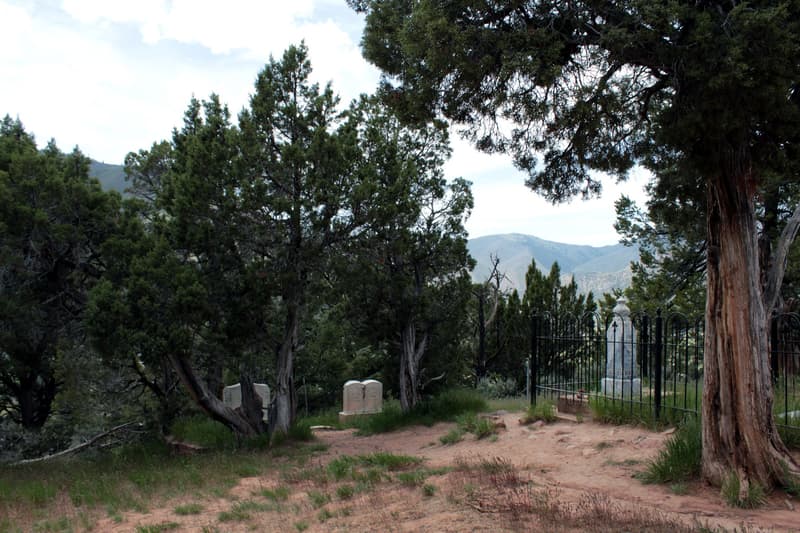
Doc was buried in Linwood Cemetery, on the hill above Glenwood Springs. The exact location of the grave is uncertain, but there is evidence that he lies at or close to where the marker stands.
Kate sent Doc’s possessions to his family in Georgia and returned to Globe, Arizona, the day after the funeral. Charlie Smith left Glenwood on November 10.
The Doc Holliday legend lives on
Doc Holliday remains one of the best-known names of the Old West. A few signs of that:
- Movies and classic TV westerns have featured him again and again.
- There is the much-loved 1993 movie Tombstone, and all the memorable quotes that came out of Val Kilmer’s portrayal. Read more about Val Kilmer as Doc Holliday.
- Tombstone keeps his memory alive with re-enactments and events; see our current Tombstone events guide for what’s on.
- Doc’s hometown of Griffin, Georgia, holds a Doc Holliday Festival.
- Plenty of fans honor him with a Doc Holliday tattoo; we collect tattoo ideas on Pinterest.
References
1 “John Henry Holliday Family History”. Kansas Heritage Group. Archived from the original on November 16, 2017. Retrieved January 4, 2018.
2 Siebert, D. (2018). Valdosta Institute. Digital Library of Georgia. Retrieved from Georgia Info, an Online Georgia Almanac on January 4, 2018.
3 Wilcox, V. (2001). Mischievous minor: From lad to Luger. True West: History of the American Frontier. Retrieved January 5, 2018 from https://truewestmagazine.com/mischievous-minor/
4 Doc Holliday Biography.com (April 27, 2017). The Biography.com website published by A&E Television Networks. Retrieved January 4, 2018 from https://www.biography.com/people/doc-holliday
5 Traywick, B. (October 1997). Doc Holliday. Wild West Magazine. Archived from the original on May 11, 2016. Retrieved January 4, 2018.
6 Ballard, S. (n.d.). Facts any good Doc Holliday aficionado should know (and probably doesn’t). Tombstone Times. Retrieved January 4, 2018 from http://www.tombstonetimes.com/stories/facts.html
7 Gillen, P. (2017). I am John H. Holliday DDS: You may call me Doc. Bloomington IN: Authorhouse.
8 Traywick, B. (n.d.). The infamous Doc Holliday. The Tombstone News. Retrieved January 5, 2018 from http://thetombstonenews.com/the-infamous-doc-holliday-p1201-84.htm
9 Jay, R. (August 14, 2006). Spitting lead in Leadville: Doc Holliday’s last stand. HistoryNet. Wild West Magazine. Retrieved January 6, 2018 from http://www.historynet.com/spitting-lead-in-leadville-doc-hollidays-last-stand.htm
10 Holliday Tanner, K. & Brewer, C. (November 1, 2001). Doc Holliday’s last days: The Origen Charles Smith memoir. True West Magazine. Retrieved January 6, 2018 from https://truewestmagazine.com/doc-hollidays-last-days/
One comment
Do you believe in reincarnation? I do, and I believe I was John Jenry Holliday in one of my past lives.