Allen English was a Tombstone attorney, well known in town and throughout Arizona. He was an educated man with a wild streak, famous for his courtroom showmanship and his barroom antics.
Some visitors come looking for him because his house still stands in historic Tombstone. Others are interested in the law and the flair with which he practiced it. Here is his story.
From Michigan to Tombstone
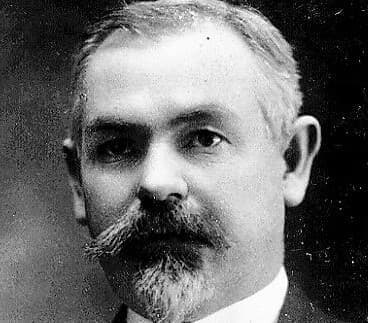
Allen English was born in Saginaw, Michigan, in 1858. His father was in the shipbuilding trade. His mother’s family, the Fitzgeralds, were Irish immigrants to Maryland.1 By 1878, at about age 20, Allen had a law degree.3
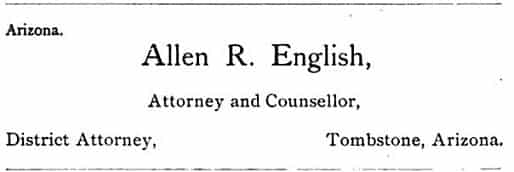
English came to Tombstone in 1880. He tried his hand at mining first, but no claims paid off. Then he met a local attorney and joined his law partnership.1 That was the start of his colorful Tombstone reputation. By 1886 he was advertising his services regularly, and legal notices in the local papers show he was also acting as a notary.

Cochise County District Attorney
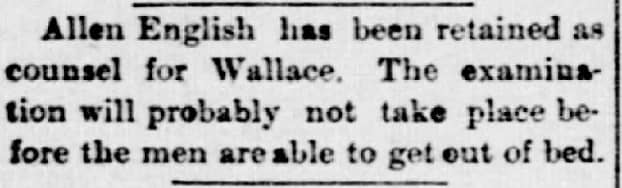
In May 1887 the county appointed Allen English district attorney. The job was mainly that of a prosecutor, but at times it also called for him to take the defense.
He developed a style all his own. He was a large man with a booming voice, and he loved showmanship. His courtroom speeches were full of quotes from Shakespeare, Latin phrases, and references to mother and the flag,1 all delivered with tear-jerking or solemn drama.
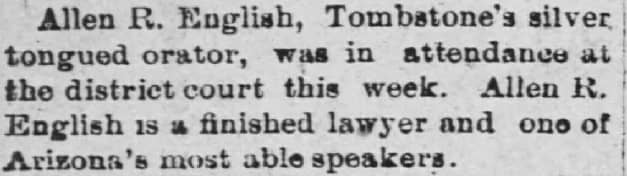
Townsfolk came to court just to watch him in action, and he became the talk of Tombstone. He also knew his law. His own law library probably held more than two thousand volumes, plus many more on related subjects, and was said to be “one of the most complete libraries in the West.”4
His first term as district attorney came by appointment, after the previous D.A. resigned. His popularity then got him reelected for two more terms, which the local papers often remarked on.
Known for His Antics
One of his courtroom tricks was to loudly ask the bailiff for a chew of tobacco,1 or even one of the jurors. After working the wad in his cheek for a while, he would aim at the spittoon across the room and hit it.3
Another episode came during the usual dry season. He was in King’s Saloon with a few others when a bet started over whether it would rain on San Juan Day, June 24. English bet it wouldn’t. If it did rain, he said, he would “strip naked and stand under that water spout.”1
Sure enough, on June 24 it poured. True to his word, Allen English was found outside King’s Saloon under the water spout, naked as a jaybird.
A Drinking Problem
English was often seen in Tombstone’s saloons. Sometimes, when he was due in court, he was late, and you can guess where he was: holding his own court with friends in a favorite saloon, reciting legal arguments.
One well-known episode came during the Wiley Morgan case. When English was due to give the closing argument in Morgan’s appeal trial, he again failed to show up. A search party found him in a bar, thoroughly drunk, and simply dragged him back to court.1
Would you want him defending you in that condition? He gave the closing argument with pluck and poise, and the case ended in a hung jury, credited in part to his speech. Later, when people congratulated him, he couldn’t understand why. He had no memory of his argument.
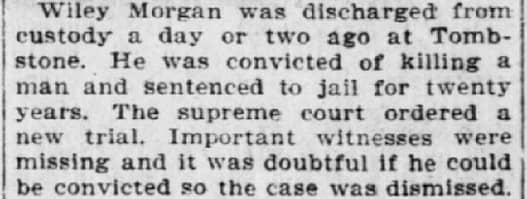
Morgan was finally released in June 1903, when he was due to be tried for the fourth time, because by then no witnesses were left to testify.
Easy Come, Easy Go
Managing money was not Allen English’s strong suit. Cash flowed in, and then it flowed out.3
In Tombstone he kept a steady stream of clients, helped by his connections in mining and his knowledge of it. For instance, he was counsel for the well-known Bunker Hill Mining Company.4
He also had a habit of billing at exorbitant rates. When he did legal work for the Calumet & Arizona Mining Company on its purchase of the Irish Mag mine, he sent a bill for $25,000 just for handling the title. The company paid, likely grudgingly, and then told him it would not need his services again.1
With cash in hand, he rewarded himself with a trip back East with his wife. They spent nearly every cent. When they returned to Tombstone, Allen English had only $20 to his name.1
Later English bought the Windsor Hotel in Tucson, with the previous owner, Martin Costello, holding the mortgage. He kept up the payments for three years, then defaulted, and Costello sued him.
Four Marriages
Allen’s first wife was Fannie Rose Carr, whom he married in 1881. They had two children, but his heavy drinking made the marriage hard for her, and she divorced him.1 Fannie and their children are buried in the Tombstone City Cemetery.
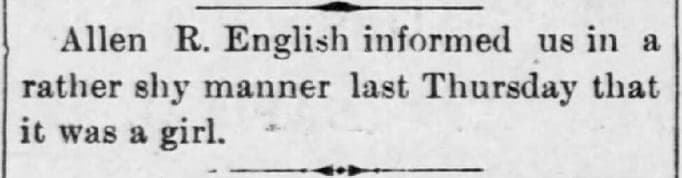
In May 1896 Allen English married his second wife, Annie V. Walsh, who had lived in Tombstone since childhood.2 They too divorced eventually.
A third wife, Honora Ada, is also mentioned. That marriage ended bitterly in April 1902, when she sued for divorce. He contested her claims of “riotous living” and carousing.
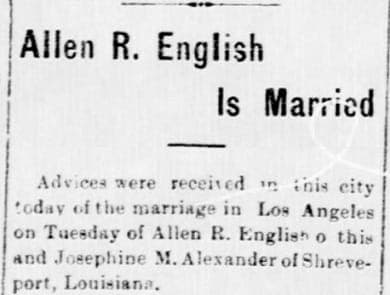
His fourth wife was Josephine M. Alexander. This marriage didn’t last either.1
A Sad Ending
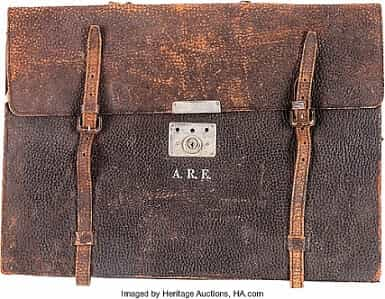
By the turn of the century, Allen English was an experienced attorney, well known in Arizona legal circles. He was considered for the post of U.S. District Attorney for the Territory of Arizona, but someone else got the job.1
When he asked why he had been passed over, he was told that a photo had been attached to his application. It showed him naked under the water spout outside the saloon, from the San Juan Day bet. We have never found out what became of that photo.
Next to it was a note: “This is the man you are considering for U.S. District Attorney?”1 Enough said.
Allen English moved to Bisbee in late 1907, where he went into partnership with attorney Tom Bennett.
In Bisbee his heavy drinking continued. One night someone found him sprawled beside the street, and a rumor went around that he was dead. He wasn’t, just passed out drunk.
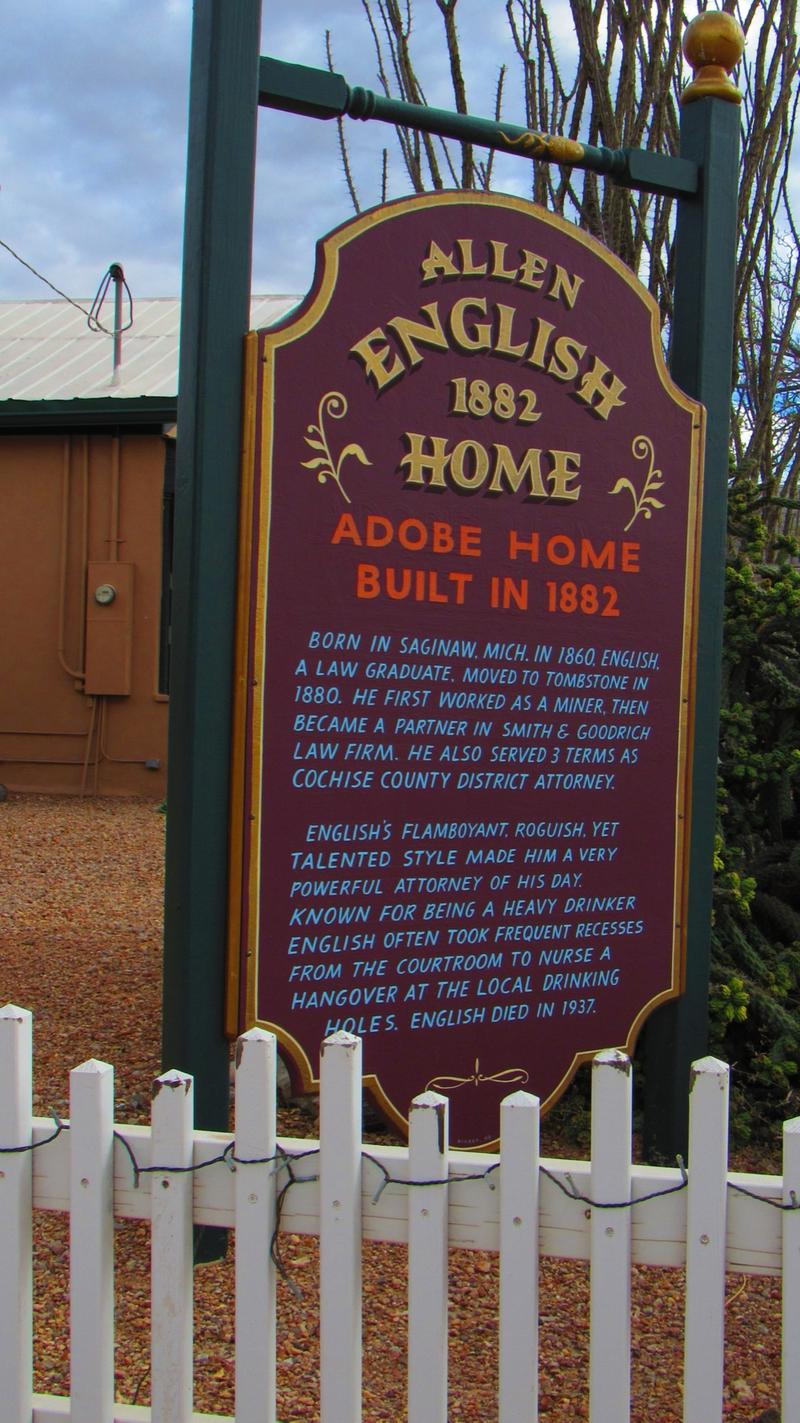
In his last years his health failed, his money was gone, and he got by with the help of friends. The historical sign at his Tombstone home says he died in 1937. It was a sad end for one of Tombstone’s most imposing characters.
The Allen English House in Tombstone
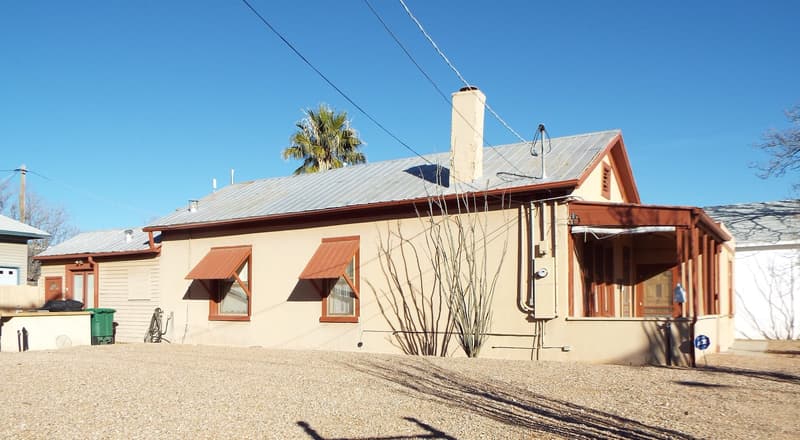
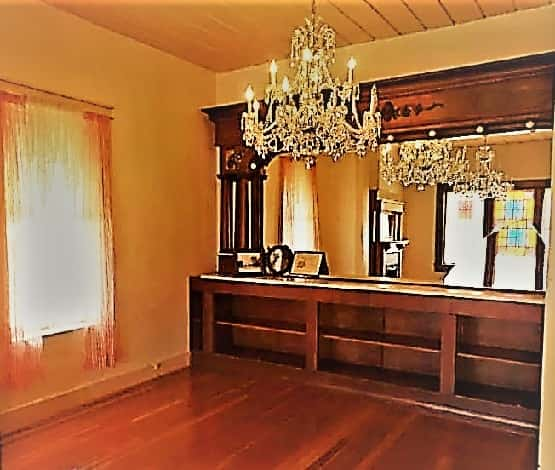
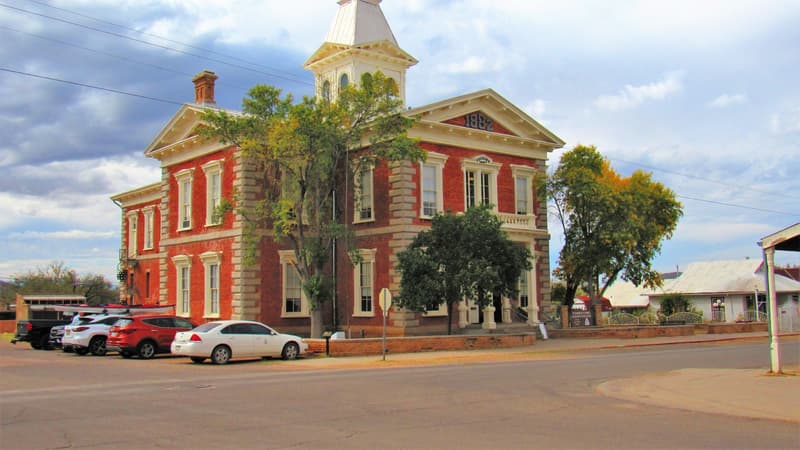
The historic Allen English home stands on the northeast corner of Toughnut and Third streets, at 304 East Toughnut Street, across from the old courthouse.
As far as we know, it has never been open to the public. A sign on the corner sums up why the home is historic, and now you know the stories behind it.
The house has changed hands several times. Real estate listings have claimed that an original back bar from the Oriental Saloon is inside. We always wonder whether an owner will do something more with the home.
For now, enjoy picturing this plucky, unabashed counselor of old as you look at his house. We doubt he spent much time relaxing in its sitting room.
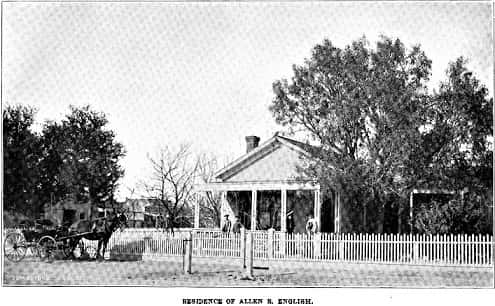
Go by that corner, take a look, and imagine his wild days, when the house looked much like it does in this 1903 photo:
References
1 Eppinga, J. (2014, Nov. 14) Cochise County attorney Allen R. English. Arizona Capitol Times. Retrieved from azcapitoltimes.com/news/2014/11/14/cochise-county-attorney-allen-r-english/
2 Arizona Weekly Citizen (1896, 16 May). Wedding bells do ring: English-Walsh. Tucson Arizona. Retrieved from Newspapers.com
3 Trimble, M. (2018). Arizona oddities: Land of anomalies & tamales. Charleston, SC: Arcadia Publishing Inc.
4 Tombstone Daily Prospector (1903, April). Tombstone in history, romance and wealth. Souvenir Edition Commemorating Arrival of the Railroad to Tombstone, Arizona. Digital Copy Retrieved from books.google.com/
No comments yet